Diffusion-Limited Aggregation Screensaver
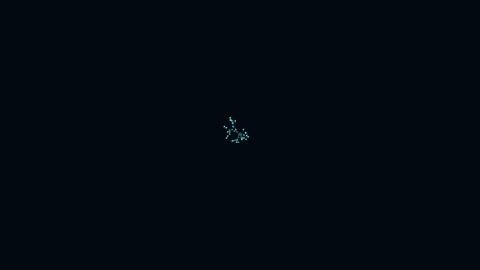
The Diffusion-Limited Aggregation screensaver simulates real particles wandering randomly until they stick, building fractal branching structures. It is free, runs in your browser, and ESC exits.
Live preview
Press ESC to leave fullscreen. Settings are saved in your browser only.
How the Diffusion Limited Growth screensaver works
The saver releases particles that wander in a real random walk until they touch the growing structure and stick.
Over time, this builds the same real fractal branching pattern seen in frost crystals and mineral deposits.
Once the structure grows large, it fades and a fresh random-walk aggregation begins.
This is the same real diffusion-limited aggregation process studied in physics and materials science.
Witten and Sander's aggregation model
Diffusion-limited aggregation was described in 1981 by the physicists Thomas Witten and Leonard Sander, in a paper in Physical Review Letters. The model starts with a single fixed seed and releases other particles one at a time. Each wanders randomly (a random walk, the same mathematics as Brownian motion), and the moment one touches the cluster it sticks for good, becoming part of the structure.
The surprising result is a branching, fractal shape. Tips that stick out are far more likely to catch a wandering particle than the deep fjords between branches, which are shielded by the arms around them. So the tips grow faster, shield the gaps further, and the cluster develops delicate arms with empty space inside. For free particles in the plane, the dimension of the finished pattern comes out at about 1.71, between a line and a filled area.
Systems that follow similar rules include electrodeposition of metal onto an electrode, mineral deposits and dielectric breakdown. The model is a simplification, not a recipe for any of them, and the resulting branch pattern changes each run because every walk is random. It is also costly to simulate, since a particle may wander a long time before it hits the cluster.
A worked example
A wandering particle drifts randomly across the screen before finally brushing a branch tip and sticking, extending the fractal outward by one more node.
Settings & tips
- Accent recolours the growing structure.
- Based on the real diffusion-limited aggregation process studied in physics.
- The same real math describes frost and mineral crystal growth.
Frequently asked questions
- Is this based on real physics?
- Yes — real diffusion-limited aggregation, studied in physics and materials science.
- Is a key needed?
- No — it is a pure local simulation.
- Is it free?
- Yes — free, no download, in your browser.
- Does the pattern repeat?
- No — the random walk means every growth structure is unique.
- Why does the cluster grow branches instead of a solid blob?
- Particles reach the outer tips first, which screens the interior from later arrivals. That positive feedback amplifies bumps into arms.
- What is the fractal dimension of a DLA cluster?
- For free particles in two dimensions it comes out at about 1.71, meaning it fills more than a line but far less than a solid area. Lattice-based simulations give slightly different values.
- Is the pattern the same every time?
- No. Each particle takes a random walk, so the exact branches differ every run, although the overall branching character and fractal dimension are statistically similar.