Procedural Prose Generator Screensaver
The Procedural Prose Generator screensaver generates infinite prose live from a real Markov chain trained on public-domain literature. It is free, runs in your browser, and ESC exits.
Live preview
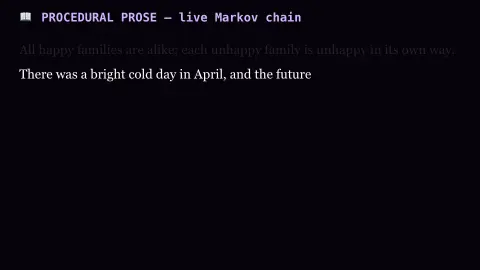
Press ESC to leave fullscreen. Settings are saved in your browser only.
How the Procedural Prose Generator screensaver works
The saver builds a real word-level Markov chain from a small seed of real, public-domain literary text.
New sentences are generated live by following real probable word-to-word transitions learned from that text.
The result recombines real language patterns into new, never-before-written sentences that scroll on endlessly.
The source text is genuinely public domain, so nothing here reproduces any copyrighted work.
Markov chains, from Russian poetry to text toys
Andrey Markov, a Russian mathematician, introduced the chains that bear his name in the early twentieth century. A Markov chain is a process in which the next step depends only on the current state, not on the full history. Markov himself later applied the idea to literature, studying the distribution of vowels in Pushkin’s novel in verse, Eugene Onegin.
Applied to words, the method is simple. You scan a body of text and record, for each word or short run of words, which words came next and how often. To generate new text you pick a start, choose a follower at random in proportion to those counts, then repeat from the new position. The Usenet program Mark V. Shaney, designed by Rob Pike and coded by Bruce Ellis, did this in 1984 with a third-order chain, picking each word from those that followed the previous two in its source text.
Because each choice looks only a short way back, the output reads fluently within a clause but wanders in meaning, and it can only echo the vocabulary and style of its source. It has no understanding of what it says, which is exactly why the result is so pleasingly odd.
A worked example
A generated sentence blends the real cadence of two different source texts into a single new line that never actually appeared in either one.
Settings & tips
- Accent recolours the generated text.
- Trained on real, genuinely public-domain literary excerpts.
- Every run produces different, freshly generated sentences.
Frequently asked questions
- Is this AI-generated text?
- No — it is a classic real Markov chain, a much simpler statistical technique, not a language model.
- Is the source text copyrighted?
- No — the seed text is genuinely public domain.
- Is a key needed?
- No — it is a pure local computation.
- Is it free?
- Yes — free, no download, in your browser.
- What does the order of a Markov chain mean?
- It is how many previous words the generator looks at when choosing the next one. Mark V. Shaney used three-word sequences, so it was a third-order chain. A higher order gives more coherent text but copies the source more closely.
- Why does the text sound grammatical but make no sense?
- Each word is chosen only by its immediate neighbours in the source, so short stretches look natural while the thread of meaning is lost over longer ones.
- Is a Markov chain the same as a modern language model?
- No. A Markov text generator uses simple counts over a short window, whereas modern neural models learn patterns over much longer contexts.