WebGL Raymarched Fractal Screensaver
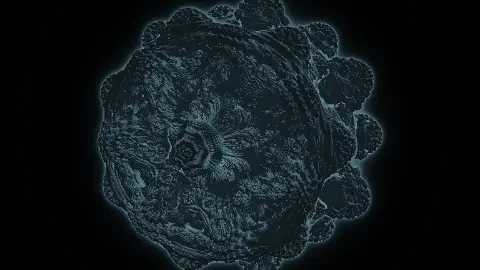
The WebGL Raymarched Fractal screensaver renders a real 3D Mandelbulb fractal live on your GPU, sphere-traced through a WebGL fragment shader with real lighting. It is free, runs in your browser, and ESC exits.
Live preview
Press ESC to leave fullscreen. Settings are saved in your browser only.
How the WebGL Raymarched Fractal screensaver works
The saver compiles a real WebGL fragment shader that sphere-traces a distance-estimated 3D fractal surface, evaluated fresh every single frame.
A real Lambertian lighting model shades the surface from a fixed light direction, with iteration-count ambient occlusion for depth.
The camera slowly orbits the fractal, revealing real structural detail from every angle.
Unlike the site's 2D canvas savers, this one runs true 3D math entirely on your graphics card via WebGL.
Mandelbulbs, distance estimators and sphere tracing
The Mandelbulb is a three-dimensional relative of the Mandelbrot set. A canonical 3D Mandelbrot set does not exist, because there is no three-dimensional analogue of the complex numbers. In 2009 Daniel White and Paul Nylander instead defined a power operation on 3D vectors using spherical coordinates, where the angles are multiplied by the power n. Iterating that operation gives a bulb-like shape with fractal surface detail, and many renderings use n = 8.
There is no polygon mesh to draw. Instead, the shader asks, for each pixel, how far a ray can safely travel before it might hit the surface. A distance estimator, derived from how fast the iteration escapes to infinity, gives a conservative answer to that question, and sphere tracing steps the ray forward by exactly that distance until it either gets very close or gives up. Detail is limited by the number of iterations, not by a stored model.
It is demanding because every pixel runs that loop on every frame, which is exactly the kind of parallel work a graphics card handles well. Slower devices may lower the frame rate or fall back, and results vary slightly between GPUs because of floating-point differences.
A worked example
As the camera drifts around the structure, real self-similar bulbous forms come into view at every scale, each one a genuine solution to the same fractal distance equation.
Settings & tips
- Accent tints the surface lighting.
- Runs entirely on your GPU via a real WebGL shader — no images or video involved.
- Requires a browser and device with WebGL support.
Frequently asked questions
- Is this a real 3D render?
- Yes — a real WebGL fragment shader sphere-traces genuine 3D fractal geometry every frame.
- What if my browser doesn't support WebGL?
- A clear message appears instead of the fractal — no crash, just an honest fallback.
- Is a key needed?
- No — it runs entirely locally on your GPU.
- Is it free?
- Yes — free, no download, in your browser.
- Why is it called a Mandelbulb?
- It is named for its resemblance to the Mandelbrot set, but it is a distinct three-dimensional construction defined by Daniel White and Paul Nylander in 2009 using spherical coordinates.
- What is a distance estimator?
- It is a formula that returns a safe lower bound on the distance from a point to the fractal surface, so a ray can step forward without skipping over thin features.
- Why does it need a fast GPU?
- Each pixel runs an iterative calculation many times per frame, so the cost grows with resolution and detail.