Where the Atoms Sat Screensaver
The Where the Atoms Sat screensaver shows crystal structures published this year, gathered key-less by the pipeline from the Crystallography Open Database. Most have no name because most are not minerals — the formula is the identity and the paper title is why anyone made it. It's free, runs in your browser, and ESC exits.
Live preview
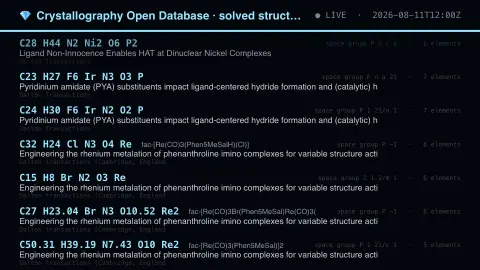
Press ESC to leave fullscreen. Settings are saved in your browser only.
How the Where the Atoms Sat screensaver works
The saver reads the source described above and draws it on a canvas — no account, no tracking.
Crystal structures published this year, gathered key-less by the pipeline from the Crystallography Open Database. Most have no name because most are not minerals — the formula is the identity and the paper title is why anyone made it.
It refreshes on a schedule, so what you see stays current.
Colours and any options can be changed in settings; nothing is stored beyond your own browser.
Reading the Crystallography Open Database
The Crystallography Open Database (COD) is an open-access collection of crystal structures of small molecules and small to medium-sized unit-cell crystals, covering organic, inorganic and metal-organic compounds but not large biological macromolecules, which belong in the Protein Data Bank. It was founded in 2003 by Armel Le Bail, Lachlan Cranswick, Michael Berndt, Luca Lutterotti and Robert M. Downs. Since December 2007 the main server has been maintained at the Vilnius University Institute of Biotechnology by Saulius Gražulis and Andrius Merkys.
Entries use the CIF format defined by the International Union of Crystallography, and every entry is freely downloadable, reusable and redistributable. A CIF records the structure: the unit cell, the symmetry and where the atoms sit. This saver reads newly published structures and shows their formulas and titles.
A structure is a measured model, not a photograph. It is fitted to diffraction data, and quality varies with the crystal and the refinement. Formulas can contain non-integer counts when a site is only partly occupied or the crystal is disordered. The list reflects what authors deposited, so it samples chemistry papers, not the universe of materials.
A worked example
Crystal structures published this year, gathered key-less by the pipeline from the Crystallography Open Database. Most have no name because most are not minerals — the formula is the identity and the paper title is why anyone made it.
Settings & tips
- Accent and Background recolour the display.
- Every value on screen comes from the live source — nothing is simulated.
- Press ESC to leave fullscreen.
Frequently asked questions
- Is this real data?
- Yes — it comes from the source named on this page and is refreshed on a schedule.
- Is a key needed?
- No. This source is fully key-less.
- Is it free?
- Yes, and it runs entirely in your browser.
- Why are there decimals in a chemical formula?
- Partial occupancy and disorder mean some atoms or solvent molecules are present in only part of the crystal, so a refined formula can include fractional counts.
- Why do most entries lack a common name?
- Minerals have names, but many structures are synthetic compounds made in laboratories, so the formula and the paper title are what identify them.
- Can I reuse COD data?
- COD says every entry is freely downloadable, reusable and redistributable without restriction.