Citizen Air Sensors Screensaver
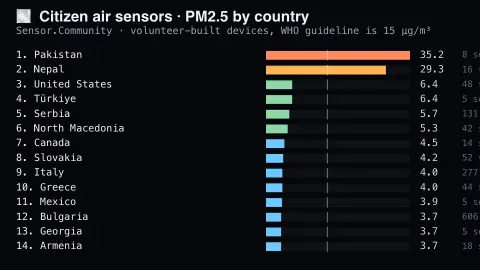
The Citizen Air Sensors screensaver shows pM2.5 readings from Sensor.Community, the volunteer network of self-built air quality sensors, gathered key-less by the pipeline. It's free, runs in your browser, and ESC exits.
Live preview
Press ESC to leave fullscreen. Settings are saved in your browser only.
How the Citizen Air Sensors screensaver works
The saver reads the source described above and draws it on a canvas — no account, no tracking.
PM2.5 readings from Sensor.Community, the volunteer network of self-built air quality sensors, gathered key-less by the pipeline. These are hobbyist devices on balconies rather than reference monitors, and the network is dense wherever people happened to build them.
It refreshes on a schedule, so what you see stays current.
Colours and any options can be changed in settings; nothing is stored beyond your own browser.
What PM2.5 from citizen sensors means
Sensor.Community grew out of luftdaten.info, a citizen project from Stuttgart in which people around OK Lab Stuttgart built low-cost fine-dust sensors that anyone could rebuild, to measure the air outside their own homes. Volunteers place them in many kinds of spot, from balconies to parks, and readings are collected by a backend, shown on a public map and archived.
PM2.5 is the mass concentration of airborne particles smaller than 2.5 micrometres, reported in micrograms per cubic metre. This saver aggregates the readings by country using a median, so one malfunctioning unit cannot dominate the figure, and it shows how many sensors contributed. A country with only a handful of sensors has a median that can say more about a few neighbourhoods than about the nation.
These optical sensors are cheap, and they can be thrown off by humidity, because water droplets are hard to tell apart from dust particles. Readings can also differ between sensors from different batches. Official monitoring stations remain the standard for health reporting, and this display is better at showing patterns and volunteer coverage than at giving an authoritative air-quality number.
A worked example
PM2.5 readings from Sensor.Community, the volunteer network of self-built air quality sensors, gathered key-less by the pipeline. These are hobbyist devices on balconies rather than reference monitors, and the network is dense wherever people happened to build them.
Settings & tips
- Accent and Background recolour the display.
- Every value on screen comes from the live source — nothing is simulated.
- Press ESC to leave fullscreen.
Frequently asked questions
- Is this real data?
- Yes — it comes from the source named on this page and is refreshed on a schedule.
- Is a key needed?
- No. This source is fully key-less.
- Is it free?
- Yes — free, no download, in your browser.
- Why do some countries have so few sensors?
- The network exists where volunteers chose to build and host devices, so coverage is dense in some places and sparse in others. Sensor count is shown because a thin sample is less reliable.
- Can I compare this with official air-quality figures?
- Only loosely. Official stations use calibrated reference methods, while hobby sensors vary in placement, humidity response and upkeep.