Cellular Automaton Rule 30 Screensaver
The Cellular Automaton Rule 30 screensaver runs the real Wolfram Rule 30 automaton live, generating complex patterns from one simple rule. It is free, runs in your browser, and ESC exits.
Live preview
Press ESC to leave fullscreen. Settings are saved in your browser only.
How the Cellular Automaton Rule 30 screensaver works
The saver computes each new row of cells from the row above using the real, well-documented Rule 30 lookup table.
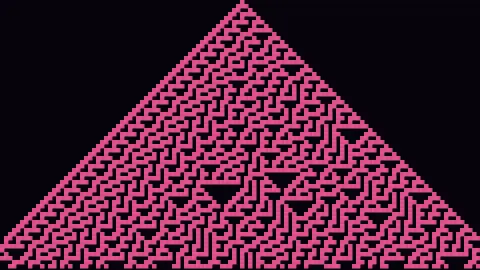
Despite the rule's simplicity, the result is a genuinely complex, non-repeating triangular pattern.
Once the pattern reaches the bottom of the screen, a fresh single-cell seed starts a new run at the top.
Rule 30 is the same automaton Stephen Wolfram used to argue that simple rules can produce real computational complexity.
Rule 30, elementary automata and randomness
An elementary cellular automaton is a row of cells, each on or off, that updates in steps. A cell's next state depends only on itself and its two neighbours, giving eight possible neighbourhoods. Each can lead to an on or off result, so there are exactly 256 rules, and Stephen Wolfram numbered them 0 to 255 by reading the eight outcomes as a binary number. For Rule 30 that is 00011110, which is 30 in decimal.
Wolfram introduced Rule 30 in 1983. Started from a single on cell, it produces a pattern whose centre column looks random even though the rule is trivially simple and fully deterministic. Versions of Mathematica before 6.0 used that column to generate random integers. Whether the column is truly random in a mathematical sense is open: in 2019 Wolfram announced three Rule 30 prize problems of $10,000 each, concerning nonperiodicity, equal frequencies of 0s and 1s, and the computation needed to find the column.
The behaviour is a showcase for his later argument, set out in the book A New Kind of Science, that simple programs can generate complexity. Other rules behave differently: Rule 110 has been proved capable of universal computation.
A worked example
A single seed cell at the top expands into an increasingly intricate triangular pattern, with genuinely unpredictable structure despite the rule's simplicity.
Settings & tips
- Accent recolours the live cells.
- Based on the real, well-documented Wolfram Rule 30 automaton.
- The pattern never repeats — Rule 30 is known to generate genuine pseudo-randomness.
Frequently asked questions
- Is this a real, published rule?
- Yes — Rule 30 is a real, well-documented cellular automaton studied by Stephen Wolfram and others.
- Is a key needed?
- No — it is a pure local computation.
- Is it free?
- Yes — free, no download, in your browser.
- Does the pattern repeat?
- Rule 30 is known to generate genuinely non-repeating, pseudo-random patterns.
- Why is Rule 30 called chaotic if it is deterministic?
- Deterministic means the same start always yields the same result. Chaotic here means the pattern looks irregular and no shortcut for predicting it is known. Whether one exists is part of the open prize problems.
- What is Rule 110?
- Another elementary automaton. Matthew Cook showed it is Turing complete, meaning it can in principle carry out any computation. He presented the proof at the Santa Fe Institute's CA98 conference and published it in 2004.
- Does the triangle ever run out of room?
- On a finite screen the pattern spreads until it hits the edges. In theory, on an infinite row, it would keep growing one cell outward each step.