State Of The Chain Screensaver
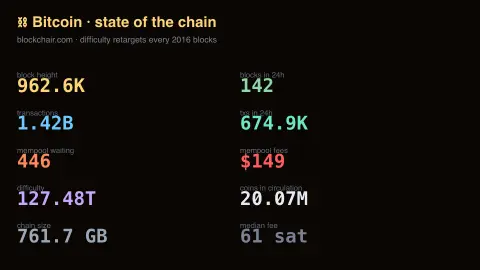
The State Of The Chain screensaver shows the Bitcoin network's operating numbers rather than its price: block height, blocks and transactions in the last 24 hours, mempool backlog, total pending fees, difficulty, coins in circulation and the size of the chain on disk. It runs in the browser with nothing to install; press ESC to exit.
Live preview
Press ESC to leave fullscreen. Settings are saved in your browser only.
How the State Of The Chain screensaver works
The saver reads Blockchair's public statistics endpoint, key-free.
No account and no key: the request goes straight from your browser, or from this site's own refreshed copy of the feed where the source does not allow browser access.
Values are drawn on a canvas that resizes with the window, so it works on a laptop or a wall display.
If the source is unreachable the saver says so on screen rather than showing stale numbers as though they were current.
Reading Bitcoin's vital signs
Blockchair is a blockchain search and analytics service, and its API serves summary statistics for Bitcoin and other chains. For Bitcoin, that summary describes the network as a machine rather than a market: how long the chain is, how hard it is to add a block, and how many transactions are waiting.
Block height is the number of blocks between a block and the first one, the genesis block, which is block 0. Difficulty is adjusted every 2,016 blocks: nodes compare the timestamps in those blocks to see how long they took and adjust the target, aiming for two weeks, which works out to one block per ten minutes. The mempool is a node’s local collection of unconfirmed transactions that could go into the next block; it is held in non-persistent memory, so a restarting node loses it.
Two cautions. The mempool is not a single shared list: each full node keeps its own, so one provider’s backlog figure is a view from that provider’s nodes. Likewise, each full node stores the blocks it has validated for itself, so size on disk describes a node’s copy of the chain. None of these numbers say anything about the price of bitcoin.
A worked example
Ten labelled figures in a grid. Difficulty moves slowly — it retargets every 2016 blocks, roughly a fortnight — while the mempool count and its total pending fee swing within hours as the queue builds and clears. Circulation is divided down from satoshis, because drawn raw it would read as two quadrillion bitcoin.
Settings & tips
- Accent and Background recolour the display without changing the data.
- Add it to a Multi-view grid to watch it alongside other live savers.
- Press ESC at any time to leave fullscreen.
Frequently asked questions
- What is the mempool?
- The queue of transactions that have been broadcast but not yet included in a block. When it grows, fees rise, because users bid against each other for the limited space in the next block.
- Why does difficulty change?
- The network targets one block every ten minutes. Every 2016 blocks it recalculates how hard the mining puzzle must be to hold that pace as mining power joins or leaves.
- Is this real data?
- Yes. It comes from Blockchair's public statistics endpoint, key-free. Nothing is invented or simulated, and if the source cannot be reached the saver reports that instead of drawing something plausible.
- Does it cost anything or need an account?
- No. Every screensaver here is free, runs in the browser and needs no sign-up. This one uses a public API that requires no key.
- Why does the time between blocks vary so much?
- Finding a block is a random process: each hash attempt has some chance of meeting the target. The ten-minute figure is an average that the 2,016-block difficulty adjustment steers toward, not a fixed interval.
- What are the fees in the mempool?
- They are the fees attached to transactions that have been broadcast but not yet included in a block, which are an incentive for miners to include them.
- Does a bigger mempool mean the network is in trouble?
- Not by itself. The mempool is just a node’s list of unconfirmed transactions, and it grows and shrinks as transactions arrive and blocks confirm them.