The Ones That Cross Mars Screensaver
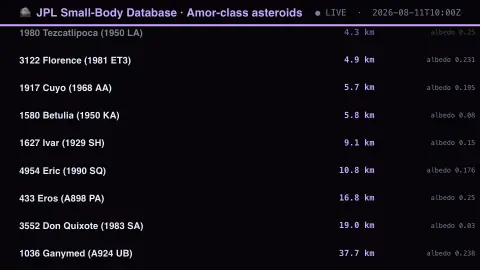
The The Ones That Cross Mars screensaver shows amor-class asteroids from JPL's Small-Body Database, key-less. Amors approach Earth's orbit without crossing it — they cross Mars instead — and Eros, the first asteroid discovered and the first landed on, is one. Diameter and albedo are blank for most of the class because knowing how big a rock is requires thermal observations most have never had, so a blank is drawn as a dash and never as a zero. It's free, runs in your browser, and ESC exits.
Live preview
Press ESC to leave fullscreen. Settings are saved in your browser only.
How the The Ones That Cross Mars screensaver works
The saver reads the source described above and draws it on a canvas — no account, no tracking.
Amor-class asteroids from JPL's Small-Body Database, key-less. Amors approach Earth's orbit without crossing it — they cross Mars instead — and Eros, the first asteroid discovered and the first landed on, is one. Diameter and albedo are blank for most of the class because knowing how big a rock is requires thermal observations most have never had, so a blank is drawn as a dash and never as a zero.
It refreshes on a schedule, so what you see stays current.
Colours can be changed in settings; nothing is stored beyond your own browser.
Amor asteroids and the data behind them
The Small-Body Database is maintained by NASA’s Jet Propulsion Laboratory and holds identification and naming information, orbital data and selected physical data for known asteroids and comets, along with close-approach information. Orbits are computed by JPL’s Solar System Dynamics group, while the physical parameters are collected from external sources and given for reference.
An amor is a near-Earth asteroid whose closest point to the Sun lies beyond Earth’s farthest distance, about 1.017 AU, but below 1.3 AU, so its orbit approaches Earth’s from outside without crossing it. Most amors cross the orbit of Mars. The first asteroid orbited and landed on by a spacecraft, 433 Eros, is one.
Two physical columns matter here. Diameter is an estimate of size, and albedo is the fraction of sunlight a surface reflects. The two are tied together through an object’s brightness, which is why a database may have to estimate a diameter from absolute magnitude using an assumed albedo, as SBDB does for its impact-risk entries. Where neither has been measured, the value is simply missing, and the saver draws a dash, never a zero.
A worked example
Amor-class asteroids from JPL's Small-Body Database, key-less. Amors approach Earth's orbit without crossing it — they cross Mars instead — and Eros, the first asteroid discovered and the first landed on, is one. Diameter and albedo are blank for most of the class because knowing how big a rock is requires thermal observations most have never had, so a blank is drawn as a dash and never as a zero.
Settings & tips
- Accent and Background recolour the display.
- Every value on screen comes from the live source — nothing is simulated.
- Press ESC to leave fullscreen.
Frequently asked questions
- Is this real data?
- Yes — it comes from the source named on this page and is refreshed on a schedule.
- Is a key needed?
- No. This source is fully key-less.
- Is it free?
- Yes, and it runs entirely in your browser.
- What does albedo mean?
- It is the fraction of incoming sunlight that a surface reflects. Combined with brightness, it helps convert how bright an asteroid looks into an estimate of its size.
- Is every amor asteroid a potential impact threat?
- No. By definition amors stay outside Earth’s orbit at their closest approach to the Sun, and the database tracks close approaches and possible impacts separately.