Reachable Asteroids Screensaver
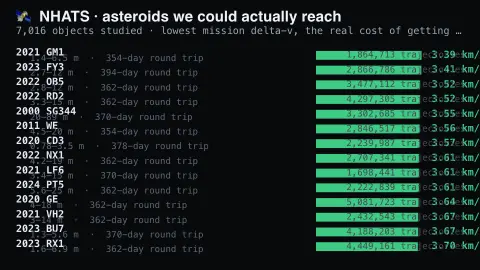
The Reachable Asteroids screensaver shows near-Earth asteroids a crewed mission could genuinely reach, from NASA's NHATS study, ranked by the lowest total delta-v any trajectory needs — the real cost of getting somewhere in space. It's free, runs in your browser, and ESC exits.
Live preview
Press ESC to leave fullscreen. Settings are saved in your browser only.
How the Reachable Asteroids screensaver works
The background pipeline reads this from NASA NHATS and saves a snapshot the saver loads.
Near-Earth asteroids a crewed mission could genuinely reach, from NASA's NHATS study, ranked by the lowest total delta-v any trajectory needs — the real cost of getting somewhere in space..
It refreshes on a schedule, so what you see stays current.
Colours can be changed in settings; nothing is stored beyond your own browser.
NHATS and the economics of reaching an asteroid
NHATS, the Near-Earth Object Human Space Flight Accessible Targets Study, began in 2010 under NASA Headquarters, and JPL's Center for Near Earth Object Studies now runs its software daily. A known near-Earth asteroid counts as accessible if at least one round-trip trajectory meets the study's limits: total delta-v of at most 12 km/s, a whole mission of at most 450 days, and at least 8 days at the asteroid, with launch inside a fixed window of years.
The headline number is delta-v, the total change in velocity a spacecraft must achieve through the whole trip, in kilometres per second. For NHATS it covers leaving a 400 km Earth parking orbit, matching the asteroid's velocity, departing it, and any speed control on Earth return. It is the currency of spaceflight because the rocket equation links it to propellant: a small increase can mean a much larger rocket. Lower values mean cheaper missions, which is why the list is ordered by it.
Other columns describe the asteroid and the opportunity. Size is given as a range in metres, estimated from absolute magnitude using albedos of 0.60 and 0.03. The viable-trajectory count is a proxy for how accessible an object is. The orbit condition code runs from 0 (well determined) to 9 (highly uncertain), and orbits are refined as observations arrive, so entries can shift. Being on the list means only that a mission is feasible on paper.
A worked example
Near-Earth asteroids a crewed mission could genuinely reach, from NASA's NHATS study, ranked by the lowest total delta-v any trajectory needs — the real cost of getting somewhere in space.
Settings & tips
- Accent and Background recolour the display.
- Run
automation/run.py nhatsto refresh the feed. - Press ESC to leave fullscreen.
Frequently asked questions
- Is this real data?
- Yes — it comes from NASA NHATS and is refreshed on a schedule.
- Why rank by delta-v rather than distance?
- Because delta-v is what actually costs fuel. An asteroid that passes close but fast is far harder to reach than a distant one whose orbit is well matched to Earth's.
- Is a key needed?
- No. This source is fully key-less.
- Is it free?
- Yes — free, no download, in your browser.
- What is delta-v?
- It is the total velocity change a spacecraft must produce over a mission. It determines how much propellant is needed, so it is used as a measure of how hard a destination is to reach.
- Why is the size given as a range?
- Size is estimated from an asteroid's absolute magnitude, which depends on how reflective it is. NHATS brackets the estimate using albedos of 0.60 and 0.03.
- Does being on the list mean a mission is planned?
- No. It means the asteroid has at least one trajectory that fits the study's limits, not that any agency has proposed a flight to it.