What Zurich Publishes Screensaver
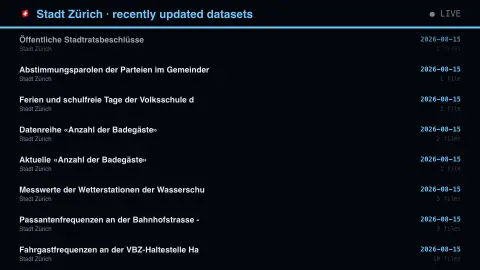
The What Zurich Publishes screensaver streams the city of Zurich's open data catalogue ordered by what was updated most recently. Zurich runs one of the more diligent municipal portals in Europe: roughly a thousand datasets covering swimming pool attendance, tram passenger counts, air quality and municipal finance, many updated daily. It runs in the browser with nothing to install; press ESC to exit.
Live preview
Press ESC to leave fullscreen. Settings are saved in your browser only.
How the What Zurich Publishes screensaver works
The saver reads The Zurich open data portal's CKAN API.
No account and no key: the request goes straight from your browser, or from this site's own refreshed copy of the feed where the source does not allow browser access.
Values are drawn on a canvas that resizes with the window, so it works on a laptop or a wall display.
If the source is unreachable the saver says so on screen rather than showing stale numbers as though they were current.
Zurich's open data portal and how to read it
The City of Zurich publishes open government data at data.stadt-zuerich.ch. The portal states that the data are free to use, including for commercial reuse, and its catalogue is organised into categories with several hundred datasets in the largest ones. It is built on CKAN, the open-source catalogue software also used by many other government portals.
Each entry in a CKAN catalogue describes a dataset and lists one or more resources, such as CSV tables, geodata layers or web services. The city's statistics office, Statistik Stadt Zürich, publishes many of the datasets, and the same entries also appear in the national opendata.swiss catalogue, which links back to the city portal. Formats offered for geodata include GeoPackage, Shapefile and GeoJSON.
When a list is ordered by most recent update, read the stamp with care. A dataset can show a recent change because its metadata was edited, a resource was replaced or new rows were appended, and these are not the same event. Titles and descriptions are mostly in German, and the exact wording of a title is the publisher's choice.
A worked example
Each row names a dataset, the department that maintains it, when it was last modified and how many files it contains. The point is less any single dataset than the breadth: somebody in Zurich is counting how many people went swimming yesterday, and publishing it.
Settings & tips
- Accent and Background recolour the display without changing the data.
- Add it to a Multi-view grid to watch it alongside other live savers.
- Press ESC at any time to leave fullscreen.
Frequently asked questions
- Why does a screensaver show a data catalogue?
- Because the catalogue is a portrait of what a well-run city measures about itself. Read as a list it is unexpectedly revealing — the things a government chooses to count are the things it is paying attention to.
- Is it in German?
- Mostly, yes. Zurich publishes its catalogue in German, and this shows the titles as the city wrote them rather than machine-translating them into something less precise.
- Is this real data?
- Yes. It comes from The Zurich open data portal's CKAN API. Nothing is invented or simulated, and if the source cannot be reached the saver reports that instead of drawing something plausible.
- Does it cost anything or need an account?
- No. Every screensaver here is free, runs in the browser and needs no sign-up. This one uses a public API that requires no key.
- What is a resource in the catalogue?
- A resource is a file or link attached to a dataset, for example a CSV table or a map layer. One dataset can have several resources in different formats.
- Does a recent update mean the numbers changed?
- Not always. The modified date can reflect a metadata edit or a re-upload as well as new figures, so it shows that something was touched, not what.
- Can anyone reuse these datasets?
- The portal says its data may be used freely, including commercially, but individual dataset pages carry the details, so check the one you want to republish.