Word Clock Screensaver
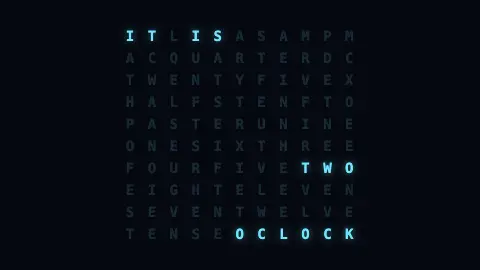
The Word Clock screensaver spells out the time on a grid of letters, lighting up words like IT IS HALF PAST TEN, in the style of the QlockTwo. It reads your device's own clock and lights the matching words, so the time it spells is accurate. It runs free in your browser with no download, and ESC exits.
Live preview
Press ESC to leave fullscreen. Settings are saved in your browser only.
How the Word Clock screensaver works
The face is a fixed 10 by 11 grid of letters that hides every phrase the clock needs. All letters are drawn dimmed; the saver then brightens only the cells that spell the current time, leaving the rest as faint background texture.
Every five seconds it reads new Date() and rounds the minutes to the nearest five. It looks up which words apply - for example TWENTY, FIVE and PAST - and whether to name the current or next hour, since QUARTER TO and similar phrases point ahead.
The lit cells fade up to full brightness with a soft text-shadow glow in your accent color and a smooth opacity transition, so the wording changes gently rather than snapping on.
Because the clock works in five-minute steps, the words update on the nearest five-minute boundary rather than every second - true to how a real word clock reads.
Telling time in words, not digits
Spelling the time out in letters is a design idea built on natural-language time. People speak it rounded to five minutes and anchored to the nearest hour, with phrases like quarter past or twenty to that deliberately avoid false precision. A letter-grid clock turns that spoken convention into hardware by hiding every needed word inside one block of letters and lighting only the relevant ones.
Designing the grid is a small puzzle. The words must be arranged so that every phrase the clock can produce reads left to right along a row, and the leftover cells are filled with filler letters. Words used together, such as half and past, have to sit in a sensible order, and some words share rows to save space. Because the vocabulary is tiny, the designer chooses filler so the grid does not accidentally spell something unintended.
The QlockTwo, from the German design studio Biegert & Funk, is the best-known wall version: a matrix of 110 letters lit from behind in five-minute steps, with dots in the corners for the minutes in between. The language matters: in German, halb zehn means half past nine, so a grid built for one language cannot simply be translated into another.
A worked example
Settings & tips
- Change the Lit color to set the glow of the active words against the dim grid.
- Raise or lower Dim letters (5 to 40%) to make the unlit background letters more or less visible.
- Set a darker Background color to make the lit phrase stand out more clearly across a room.
Frequently asked questions
- How does a word clock tell the time?
- It lights up the words for the current time on a grid of letters, so you read a phrase like IT IS HALF PAST TEN instead of digits. The unlit letters stay dim in the background.
- Is the word clock screensaver accurate?
- Yes. It reads your device's own clock and lights the matching words, rounded to the nearest five minutes the way a real word clock works. No internet connection is needed.
- Why does the word clock only change every five minutes?
- Word clocks describe time in five-minute steps, like TEN PAST or QUARTER TO. The display rounds to the nearest five minutes and updates the wording on that boundary.
- Can I change the color of the lit words?
- Yes. Use the Lit color control to set the glow of the active words, and the Dim letters control to adjust how visible the background letters are.
- Is the word clock screensaver free?
- Yes. It runs entirely in your browser with no download or account. Press ESC at any time to exit full screen.
- Why are the filler letters random-looking?
- They are chosen to complete the rectangle without forming words that could be misread as part of the time, so the lit phrase stands out.
- Do other languages use the same layout?
- No. Languages count the hours and halves differently, for instance German names the half hour in relation to the next hour, so each language needs its own grid.
- Why round to five minutes at all?
- It reflects how people speak. Giving exact minutes would need many more words and a much larger grid, which defeats the simplicity of the design.