Who Actually Said It Screensaver
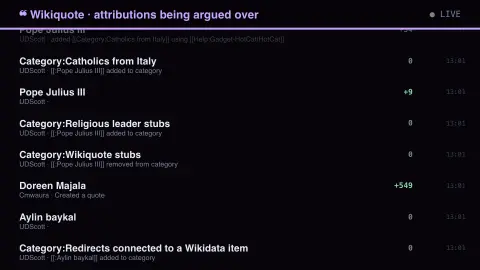
The Who Actually Said It screensaver shows live edits to Wikiquote, key-less from the MediaWiki API. A great deal of the work here is subtractive — removing quotations the person they are attributed to never said. The byte deltas show it plainly: on Wikiquote, unlike almost anywhere else, a careful sourced edit usually makes the page shorter. It's free, runs in your browser, and ESC exits.
Live preview
Press ESC to leave fullscreen. Settings are saved in your browser only.
How the Who Actually Said It screensaver works
The saver reads the source described above and draws it on a canvas — no account, no tracking.
Live edits to Wikiquote, key-less from the MediaWiki API. A great deal of the work here is subtractive — removing quotations the person they are attributed to never said. The byte deltas show it plainly: on Wikiquote, unlike almost anywhere else, a careful sourced edit usually makes the page shorter.
It refreshes on a schedule, so what you see stays current.
Colours can be changed in settings; nothing is stored beyond your own browser.
Wikiquote and the problem of misattributed quotes
Wikiquote is a sister project of Wikipedia, run by the Wikimedia Foundation and launched on its own subdomain in July 2003. It collects quotations with their sources, and it runs on MediaWiki, the same software as Wikipedia, so every change to a page is recorded in a public recent-changes log. That log is what this display draws from: the page edited and the change in page size, measured in bytes.
Quotation collecting has an unusual failure mode. Famous lines are routinely attributed to the wrong person, or reworded over time until no original source can be found. Part of the project's stated aim is to correct misattributed quotations and to give exact sources, so an edit that removes a line nobody can trace to the person it is credited to is the project working as intended. That is why many changes here shrink a page rather than grow it.
A byte delta is only a rough proxy for what changed. A negative number can mean a pruned quote, a moved section or a revert of vandalism, and a positive one can be new sourced material or a long block of discussion. The edit summary and the page history, not the number, tell the real story.
A worked example
Live edits to Wikiquote, key-less from the MediaWiki API. A great deal of the work here is subtractive — removing quotations the person they are attributed to never said. The byte deltas show it plainly: on Wikiquote, unlike almost anywhere else, a careful sourced edit usually makes the page shorter.
Settings & tips
- Accent and Background recolour the display.
- Every value on screen comes from the live source — nothing is simulated.
- Press ESC to leave fullscreen.
Frequently asked questions
- Is this real data?
- Yes — it comes from the source named on this page and is refreshed on a schedule.
- Is a key needed?
- No. This source is fully key-less.
- Is it free?
- Yes, and it runs entirely in your browser.
- What do the plus and minus numbers mean?
- They are the change in the page's size in bytes caused by that edit. They do not say whether the edit was good, only whether the text got longer or shorter.
- Can edits here include vandalism?
- Yes. The recent-changes log lists edits as they happen, including ones that other editors quickly revert.
- Does Wikiquote verify that a quote is genuine?
- It aims to give exact sources and to correct misattributions, but it is volunteer-edited, so coverage and accuracy vary from page to page.