A Newsroom Anyone Can Edit Screensaver
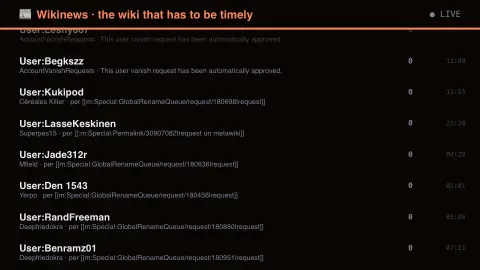
The A Newsroom Anyone Can Edit screensaver shows live edits to Wikinews, key-less from the MediaWiki API. Wikinews carries the hardest constraint of any sister project — an encyclopaedia article can be improved forever, but a news story is stale within a day. The result is an edit rate far lower and far spikier than Wikipedia's: long quiet stretches, then a burst around one story. It's free, runs in your browser, and ESC exits.
Live preview
Press ESC to leave fullscreen. Settings are saved in your browser only.
How the A Newsroom Anyone Can Edit screensaver works
The saver reads the source described above and draws it on a canvas — no account, no tracking.
Live edits to Wikinews, key-less from the MediaWiki API. Wikinews carries the hardest constraint of any sister project — an encyclopaedia article can be improved forever, but a news story is stale within a day. The result is an edit rate far lower and far spikier than Wikipedia's: long quiet stretches, then a burst around one story.
It refreshes on a schedule, so what you see stays current.
Colours can be changed in settings; nothing is stored beyond your own browser.
Wikinews and the shape of an edit stream
Wikinews is a free news source written by volunteers and hosted by the non-profit Wikimedia Foundation, with no advertising. Most articles synthesise cited reports from many sources, and the rest are original reporting by contributors. Articles aim for a neutral point of view, cite their sources and leave out opinion and commentary.
All articles must pass independent review before they reach the published stage. Unpublished articles can be edited by anyone, and after publication editing is restricted for new or unregistered accounts. Published articles are usually archived at least a week later, after which only administrators can edit them, so there is little reason to keep expanding an article once it is out.
The edits shown come from MediaWiki’s recent-changes data, which lists changes to pages, and a single story can produce a flurry of changes as it is drafted, reviewed and published, creating bursts separated by quiet periods. Edit volume measures volunteer activity, not the importance of the news. A busy hour can mean one story is being written collaboratively, while a quiet stretch may only mean contributors are offline.
A worked example
Live edits to Wikinews, key-less from the MediaWiki API. Wikinews carries the hardest constraint of any sister project — an encyclopaedia article can be improved forever, but a news story is stale within a day. The result is an edit rate far lower and far spikier than Wikipedia's: long quiet stretches, then a burst around one story.
Settings & tips
- Accent and Background recolour the display.
- Every value on screen comes from the live source — nothing is simulated.
- Press ESC to leave fullscreen.
Frequently asked questions
- Is this real data?
- Yes — it comes from the source named on this page and is refreshed on a schedule.
- Is a key needed?
- No. This source is fully key-less.
- Is it free?
- Yes, and it runs entirely in your browser.
- Who writes Wikinews articles?
- Volunteers. Anyone can contribute, though articles aim for a neutral point of view with cited sources, and every article must pass independent review before it reaches the published stage.
- Why does a burst of edits happen around one story?
- A single article often passes through drafting, source checking and review, each of which creates edits, so one story can generate many changes in a short time.