Where A Protein Lives Screensaver
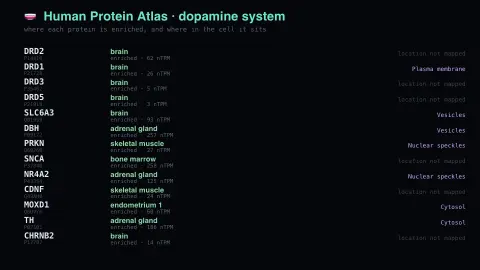
The Where A Protein Lives screensaver shows the Human Protein Atlas, key-less: for a rotating family of genes, which tissue expresses each most and where in the cell it sits. It's free, runs in your browser, and ESC exits.
Live preview
Press ESC to leave fullscreen. Settings are saved in your browser only.
How the Where A Protein Lives screensaver works
The saver reads the source described above and draws it on a canvas — no account, no tracking.
The Human Protein Atlas, key-less: for a rotating family of genes, which tissue expresses each most and where in the cell it sits. Built from antibody staining across every major human tissue, so tissue-specific means markedly enriched rather than merely detectable.
It refreshes on a schedule, so what you see stays current.
Colours and any options can be changed in settings; nothing is stored beyond your own browser.
What enriched expression means
The Human Protein Atlas is a Sweden-based research programme, started in 2003 and based at SciLifeLab, that maps where proteins are found in human tissues, cells and organs. It combines antibody-based imaging, mass spectrometry-based proteomics, transcriptomics and systems biology.
The saver picks a changing family of genes and reports, for each, the tissue where it is most expressed and where inside the cell the protein sits, such as the nucleus or mitochondria. The distinction behind the title matters: a gene that is merely detected in many tissues is not very informative, while one that is enriched in a single tissue hints at a specialised role there.
The atlas gives tissue enriched a precise meaning in its RNA data: mRNA at least four times higher in one tissue or cell type than in any other. Related categories include group enriched (a group of two to five tissues at least four times above all others) and tissue enhanced (at least four times above the average of the rest). Expression level is not function, so a location or enrichment label should be read as evidence, not proof, and the display samples gene families rather than the whole database.
A worked example
The Human Protein Atlas, key-less: for a rotating family of genes, which tissue expresses each most and where in the cell it sits. Built from antibody staining across every major human tissue, so tissue-specific means markedly enriched rather than merely detectable.
Settings & tips
- Accent and Background recolour the display.
- Every value on screen comes from the live source — nothing is simulated.
- Press ESC to leave fullscreen.
Frequently asked questions
- Is this real data?
- Yes — it comes from the source named on this page and is refreshed on a schedule.
- Is a key needed?
- No. This source is fully key-less.
- Is it free?
- Yes — free, no download, in your browser.
- What does tissue enriched mean?
- In the Human Protein Atlas, a gene is tissue enriched when its mRNA level in one tissue or cell type is at least four times higher than in any other tissue or cell type. That often points to a specialised function there.
- What is the difference between tissue enriched and tissue enhanced?
- Tissue enriched compares one tissue against every other individual tissue. Tissue enhanced compares it against the average of all the others, so more genes qualify as enhanced.
- Is this medical information?
- No. The display is a research reference showing sampled gene families, not a diagnostic tool or medical advice.