Protein Interaction Network Screensaver
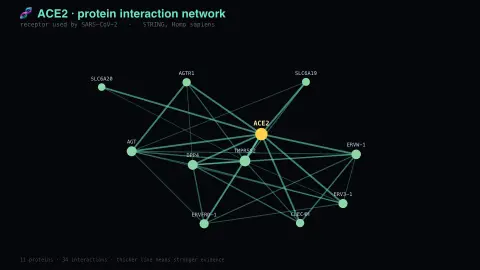
The Protein Interaction Network screensaver shows the proteins a given human gene's product is known to interact with, drawn as a force-directed graph from the STRING database, key-less. It's free, runs in your browser, and ESC exits.
Live preview
Press ESC to leave fullscreen. Settings are saved in your browser only.
How the Protein Interaction Network screensaver works
The saver reads the source described above and draws it on a canvas — no account, no tracking.
The proteins a given human gene's product is known to interact with, drawn as a force-directed graph from the STRING database, key-less. Edge thickness is STRING's confidence score, and the seed protein rotates so the picture is never the same for long.
It refreshes on a schedule, so what you see stays current.
Colours and any options can be changed in settings; nothing is stored beyond your own browser.
How STRING scores protein associations
STRING is a database of known and predicted protein-protein associations, maintained by the STRING Consortium, a collaboration of the Swiss Institute of Bioinformatics, the Novo Nordisk Foundation Center for Protein Research and EMBL. Its website lists thousands of organisms, though this saver follows human genes.
Each link between two proteins carries a combined confidence score between 0 and 1 (in practice shown from 0.150 to 0.999), calibrated to approximate the probability that the association is real. It combines separately scored evidence channels: genomic-context predictions (gene neighbourhood, gene fusion, co-occurrence across species), laboratory experiments, curated pathway databases, automated text mining and co-expression. The thickness of an edge here shows that score. An association means two proteins are functionally linked, such as sharing a pathway, and not necessarily touching physically.
The layout is a force-directed graph: connected nodes pull toward each other like springs while all nodes repel, so tightly linked groups cluster together. The position on screen carries no biological meaning beyond that clustering. A sparse neighbourhood can simply reflect a gene that has been studied less, not one that does little.
A worked example
The proteins a given human gene's product is known to interact with, drawn as a force-directed graph from the STRING database, key-less. Edge thickness is STRING's confidence score, and the seed protein rotates so the picture is never the same for long.
Settings & tips
- Accent and Background recolour the display.
- Every number on screen comes from the live source — nothing is simulated.
- Press ESC to leave fullscreen.
Frequently asked questions
- Is this real data?
- Yes — it comes from the source named on this page and is refreshed on a schedule.
- Is a key needed?
- No. This source is fully key-less.
- Is it free?
- Yes — free, no download, in your browser.
- Does a link mean the proteins physically bind?
- Not necessarily. STRING’s edges cover functional association, which includes physical binding but also shared pathways and other functional links.
- Why is the picture different each time?
- The central protein rotates through different genes, and the force-directed layout settles into a fresh arrangement for each one.