Biological Pathways Screensaver
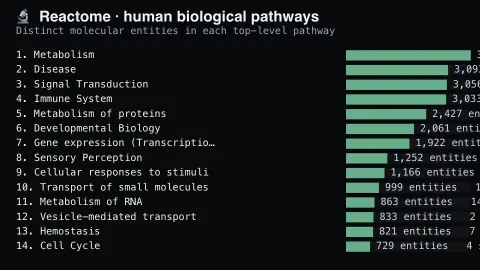
The Biological Pathways screensaver shows the top-level pathways of human biology from Reactome, ranked by how many distinct molecular entities take part — a rough measure of how much of the cell's machinery each one involves. It's free, runs in your browser, and ESC exits.
Live preview
Press ESC to leave fullscreen. Settings are saved in your browser only.
How the Biological Pathways screensaver works
The background pipeline reads this from the Reactome API and saves a snapshot the saver loads.
The top-level pathways of human biology from Reactome, ranked by how many distinct molecular entities take part — a rough measure of how much of the cell's machinery each one involves..
It refreshes on a schedule, so what you see stays current.
Colours can be changed in settings; nothing is stored beyond your own browser.
Reactome and the map of human pathways
Reactome describes itself as an open-source, open access, manually curated and peer-reviewed pathway database, founded in 2003. It is maintained by an international team from the Ontario Institute for Cancer Research, NYU Langone Health, EMBL’s European Bioinformatics Institute and Oregon Health and Science University. Instead of listing genes alone, it records reactions: which molecules convert into which others, which proteins catalyse them, and where in the cell they happen.
Entities that take part in reactions include proteins, complexes, nucleic acids and small molecules, and reactions are grouped into pathways, which nest from broad areas such as metabolism or the immune system down to smaller steps. The display shows top-level pathways and sizes them by a count of distinct molecular entities. Curation works like scientific review: an outside expert supplies knowledge, a curator encodes it, and another expert checks the result, with assertions linked to the literature.
A larger pathway is simply one whose curated description involves more distinct molecules. It does not mean it matters more to health, and it can reflect how thoroughly an area has been studied and annotated, not only its true biological complexity. Counts shift as curators add content.
A worked example
The top-level pathways of human biology from Reactome, ranked by how many distinct molecular entities take part — a rough measure of how much of the cell's machinery each one involves.
Settings & tips
- Accent and Background recolour the display.
- Run
automation/run.py reactometo refresh the pathway data. - Press ESC to leave fullscreen.
Frequently asked questions
- Is this real data?
- Yes — it comes from the Reactome API and is refreshed on a schedule.
- Why is this fetched by the pipeline?
- The lightweight top-pathways endpoint carries no entity counts. Only the full events hierarchy does, and it is several megabytes — fine for a daily server job, too heavy to pull in every browser.
- Is a key needed?
- No. This source is fully key-less.
- Is it free?
- Yes — free, no download, in your browser.
- What is a molecular entity in Reactome?
- It is a distinct participant in a reaction, such as a protein, a small molecule, a nucleic acid or a multi-protein complex.
- Why do the same proteins appear in several pathways?
- Many proteins do more than one job, and pathways overlap, so the same molecule can be annotated in several pathways.
- Is Reactome limited to human biology?
- Its manually curated content is human. Reactome also electronically infers reactions in 14 other species from the human ones using protein homology data, but these are predictions rather than experimental data.