Protein Families Screensaver
The Protein Families screensaver shows entries from InterPro at EMBL-EBI, which classifies proteins into families, domains and functional sites by combining a dozen member databases. A random page each run, so the feed wanders. It's free, runs in your browser, and ESC exits.
Live preview
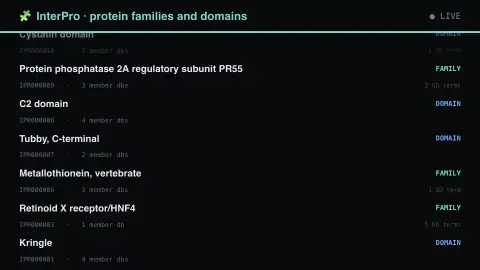
Press ESC to leave fullscreen. Settings are saved in your browser only.
How the Protein Families screensaver works
The saver reads InterPro at EMBL-EBI directly in your browser — no key and no account.
Entries from InterPro at EMBL-EBI, which classifies proteins into families, domains and functional sites by combining a dozen member databases.
It refreshes on a schedule, so what you see stays current.
Colours can be changed in settings; nothing is stored beyond your own browser.
How InterPro classifies proteins
InterPro, hosted at the European Bioinformatics Institute (EMBL-EBI), is a resource that classifies proteins into families, domains and sites; its entry types are homologous superfamily, family, domain, repeat and site. A family contains proteins that share a common evolutionary origin. A domain is a distinct structural or functional unit within a protein, and a site marks specific residues such as an active site or a binding site.
The resource does not do all the work itself. It integrates signatures from around a dozen member databases, including Pfam, PROSITE, SMART and CATH-Gene3D, each of which uses its own method, such as hidden Markov models or sequence patterns. InterPro curators merge signatures that describe the same family, domain or site into one entry, given a unique accession beginning IPR, a name and a description.
Only signatures of sufficient quality are integrated, and an entry carries a description and Gene Ontology terms where possible. A match to an InterPro entry is evidence that a protein shares a family or domain, but does not prove a specific function. The cards show entries from the catalogue, not a ranking of the most important protein families.
A worked example
Entries from InterPro at EMBL-EBI, which classifies proteins into families, domains and functional sites by combining a dozen member databases. A random page each run, so the feed wanders.
Settings & tips
- Accent and Background recolour the display.
- Data comes straight from InterPro at EMBL-EBI in your browser.
- Press ESC to leave fullscreen.
Frequently asked questions
- Is this real data?
- Yes — it comes from InterPro at EMBL-EBI and is refreshed on a schedule.
- Is a key needed?
- No. This source is fully key-less.
- Is it free?
- Yes — free, no download, in your browser.
- What do the IPR accession numbers mean?
- Each InterPro entry gets a unique accession beginning IPR. An entry integrates signatures from one or more member databases that describe the same family, domain or site.
- What is the difference between a family and a domain?
- A family groups proteins with a shared evolutionary origin, while a domain is a distinct structural or functional unit within a protein, and proteins often have several.
- Does an InterPro match prove what a protein does?
- No. It indicates a shared family or domain, which suggests but does not establish function.