Weather on This Day Screensaver
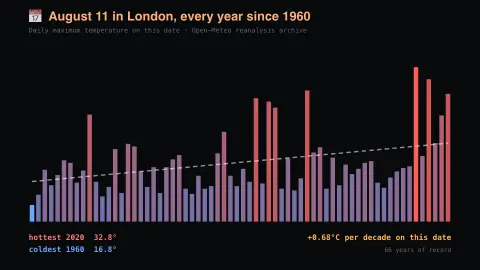
The Weather on This Day screensaver shows every recorded maximum temperature for today's date going back to 1960, from Open-Meteo's key-less reanalysis archive, with the hottest and coldest years marked and a trend line across the decades. It's free, runs in your browser, and ESC exits.
Live preview
Press ESC to leave fullscreen. Settings are saved in your browser only.
How the Weather on This Day screensaver works
The saver reads Open-Meteo's reanalysis archive directly in your browser — no key and no account.
Every recorded maximum temperature for today's date going back to 1960, from Open-Meteo's key-less reanalysis archive, with the hottest and coldest years marked and a trend line across the decades..
It refreshes on a schedule, so what you see stays current.
Colours can be changed in settings; nothing is stored beyond your own browser.
Reanalysis: how a climate archive reaches back decades
Open-Meteo is an open weather data service whose historical archive is built on reanalysis datasets. A reanalysis takes decades of observations and feeds them through a fixed modern forecasting model, producing a consistent record of the atmosphere on a regular grid. Open-Meteo lists ERA5, which reaches back to 1940, and ERA5-Land, from 1950, among its sources. Using one model throughout avoids the jumps that would come from stitching together records made with changing equipment.
The temperature for a location is the model's value for the grid cell that contains it. Open-Meteo gives ERA5 a resolution of about 25 km and ERA5-Land about 11 km, so the figure will not match a particular thermometer, especially in mountains, near coasts or in cities where conditions change over short distances. The daily maximum is a simple aggregation of the hourly values for the day, at 2 metres above ground.
Reading a single calendar date across the decades gives a small sample, one value per year, so year-to-year weather variation is large. Only a long-term pattern across many days says much about climate, and one date is a thin slice of it.
A worked example
Every recorded maximum temperature for today's date going back to 1960, from Open-Meteo's key-less reanalysis archive, with the hottest and coldest years marked and a trend line across the decades.
Settings & tips
- Accent and Background recolour the display.
- Data comes straight from Open-Meteo's reanalysis archive in your browser.
- Press ESC to leave fullscreen.
Frequently asked questions
- Is this real data?
- Yes — it comes from Open-Meteo's reanalysis archive and is refreshed on a schedule.
- Does the trend line prove anything?
- It is a least-squares fit across one calendar date at one place, so it is suggestive rather than conclusive. A single day of the year is a noisy sample of climate.
- Is a key needed?
- No. This source is fully key-less.
- Is it free?
- Yes — free, no download, in your browser.
- What is a reanalysis?
- It is a historical weather dataset produced by running past observations through a fixed forecast model, giving a consistent, gap-free picture of the atmosphere on a grid.
- Why might the value differ from my local weather station?
- The archive gives a value for a grid cell roughly 11 to 25 km across, depending on the dataset, whereas a station measures one spot, so hills, coasts and cities can make the two differ.
- Why are the hottest and coldest years so mixed?
- Weather varies a great deal from one year to the next on any given date, so extremes on a single date can fall in almost any year, and a long-term trend is hard to read from one date alone.