Wave Interference Pattern Screensaver
The Wave Interference Pattern screensaver simulates real ripple-tank physics, with multiple wave sources interfering to form constructive and destructive patterns. It is free, runs in your browser, and ESC exits.
Live preview
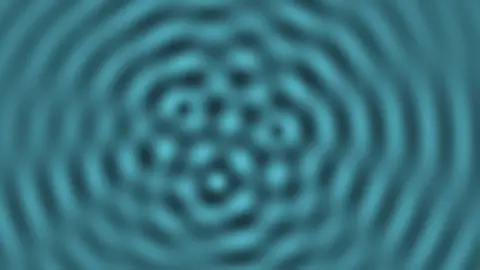
Press ESC to leave fullscreen. Settings are saved in your browser only.
How the Wave Interference Pattern screensaver works
The saver computes real wave amplitude at every point as the sum of ripples from several point sources.
Where waves align in phase, they reinforce brightly; where they cancel, dark interference bands appear.
Source positions and frequencies drift slowly, keeping the pattern always in motion.
This is the same real wave-superposition math used in physics ripple-tank demonstrations.
Interference and the principle of superposition
When two or more waves overlap, the disturbance at any point is simply the sum of the individual disturbances. This is the superposition principle, and it holds for water ripples, sound, light and radio. Where crests meet crests the result is larger (constructive interference), and where a crest meets a trough they cancel (destructive interference).
The classic demonstration is associated with Thomas Young, who around 1801–1803 set out the wave interference of light, including the idea of light passing through two narrow slits to make alternating bright and dark bands. Bright bands appear where the path lengths from the two slits differ by a whole number of wavelengths, and dark bands where they differ by an odd multiple of half a wavelength. The same geometry applies to two water ripples.
Physics teachers use a shallow tank of water called a ripple tank to show this directly, and the swirling lattice you see on screen is the equivalent for several sources at once. In real two-dimensional waves the amplitude also fades with distance as the energy spreads over a larger circle. Changing the sources’ frequencies or spacing changes the number and angle of the dark lines, which is why the pattern keeps reshaping.
A worked example
Two nearby sources produce a fan of bright and dark interference bands radiating outward, exactly matching the real classic ripple-tank demonstration.
Settings & tips
- Accent tints the wave crest color.
- Based on the real wave-superposition math used in physics demonstrations.
- Source positions drift slowly, keeping the pattern fresh.
Frequently asked questions
- Is this based on real physics?
- Yes — real wave-superposition math, the same principle behind ripple-tank demonstrations.
- Is a key needed?
- No — it is a pure local simulation.
- Is it free?
- Yes — free, no download, in your browser.
- Does the pattern repeat?
- Source positions drift slowly, so the pattern is always slightly different.
- What is constructive versus destructive interference?
- Constructive means waves line up and add, making a stronger signal. Destructive means they are out of step and subtract, reducing or cancelling the signal.
- Who first showed interference of light?
- Thomas Young is credited with establishing it, presenting his wave-interference work in 1801 and following up with demonstrations in 1803.
- Why do dark lines appear in fixed shapes?
- They sit where the distances to two sources differ by an odd multiple of half a wavelength, which defines curves that spread outward from the sources.