Every Volcano Wikidata Knows Screensaver
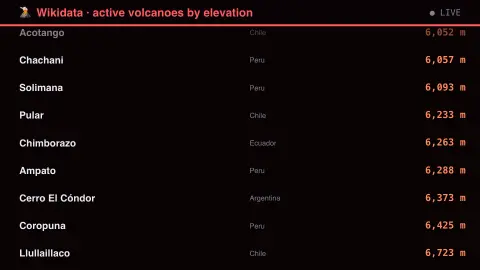
The Every Volcano Wikidata Knows screensaver shows active volcanoes by elevation, queried live against the Wikidata Query Service in SPARQL. The query is deliberately cheap: WDQS enforces a hard timeout and unbounded property paths blow through it, so this matches instance-of directly on an indexed property and returns in about a second. Elevations are only as good as the last editor to touch them. It's free, runs in your browser, and ESC exits.
Live preview
Press ESC to leave fullscreen. Settings are saved in your browser only.
How the Every Volcano Wikidata Knows screensaver works
The saver reads the source described above and draws it on a canvas — no account, no tracking.
Active volcanoes by elevation, queried live against the Wikidata Query Service in SPARQL. The query is deliberately cheap: WDQS enforces a hard timeout and unbounded property paths blow through it, so this matches instance-of directly on an indexed property and returns in about a second. Elevations are only as good as the last editor to touch them.
It refreshes on a schedule, so what you see stays current.
Colours can be changed in settings; nothing is stored beyond your own browser.
Wikidata and the language of SPARQL
Wikidata is the structured-data sibling of Wikipedia, a database in which facts are stored as statements linking an item to a value through a property: a volcano is an instance of a type of volcano, has an elevation, sits in a country, and so on. Anyone can edit it, and it feeds infoboxes and tools across Wikimedia projects and beyond.
The Wikidata Query Service lets you ask questions of that web of statements in SPARQL, a query language for graph data standardised by the W3C. A query describes a pattern, such as every item that is a volcano and has an elevation, and the service returns every match. Because the public service is shared, query runtime is limited to 60 seconds, so queries must be written to take advantage of how the data is indexed.
The results are only as good as the underlying entries. Some volcanoes are missing, others are entered more than once, and elevations may use different reference points or be left out. Whether a volcano counts as active depends on how editors have classified it, and classifications vary between sources, so this is not a definitive catalogue of volcanoes.
A worked example
Active volcanoes by elevation, queried live against the Wikidata Query Service in SPARQL. The query is deliberately cheap: WDQS enforces a hard timeout and unbounded property paths blow through it, so this matches instance-of directly on an indexed property and returns in about a second. Elevations are only as good as the last editor to touch them.
Settings & tips
- Accent and Background recolour the display.
- Every value on screen comes from the live source — nothing is simulated.
- Press ESC to leave fullscreen.
Frequently asked questions
- Is this real data?
- Yes — it comes from the source named on this page and is refreshed on a schedule.
- Is a key needed?
- No. This source is fully key-less.
- Is it free?
- Yes, and it runs entirely in your browser.
- What is SPARQL?
- It is the W3C standard query language for graph-structured data stored as subject, property and value triples. It plays a role for Wikidata roughly like SQL does for a relational database.
- Why are elevations sometimes inconsistent?
- Editors may use different sources, units or reference points, such as summit height versus height above a surrounding plain. Wikidata records whichever statement was entered.
- Can I trust this as a list of active volcanoes?
- Treat it as a rough view. Authoritative volcano lists are kept by geological surveys and programmes such as the Smithsonian's Global Volcanism Program, which use their own criteria.