When the Patient Is an Animal Screensaver
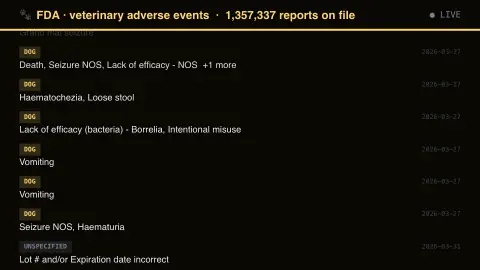
The When the Patient Is an Animal screensaver shows adverse event reports for veterinary medicines, key-less from openFDA. Not every report names a species — labelling complaints often have no animal attached — and those are shown as unspecified rather than dropped. It's free, runs in your browser, and ESC exits.
Live preview
Press ESC to leave fullscreen. Settings are saved in your browser only.
How the When the Patient Is an Animal screensaver works
The saver reads the source described above and draws it on a canvas — no account, no tracking.
Adverse event reports for veterinary medicines, key-less from openFDA. Not every report names a species — labelling complaints often have no animal attached — and those are shown as unspecified rather than dropped.
It refreshes on a schedule, so what you see stays current.
Colours and any options can be changed in settings; nothing is stored beyond your own browser.
How veterinary adverse event reports work
The US Food and Drug Administration collects adverse event reports for animal drugs. Holders of approved new animal drug applications are required to report adverse drug experiences and product defects under 21 CFR 514.80, using Form FDA 1932, while veterinarians and animal owners are encouraged to report voluntarily on a separate form. The openFDA service republishes the FDA’s Animal Drug Adverse Events data as searchable JSON, and may rename some fields.
Reports vary in detail and some information may be missing. Reporters are asked for the drugs given, the animal’s medical findings and similar context, which is why one report can read like a short clinical note. An adverse experience can be a side effect, but it can also be a drug that did not appear to work.
An entry is a report, not a finding. openFDA warns against relying on the data for medical care decisions, and a report alone does not show that a product caused the event, because animals also get sick for unrelated reasons. There is no denominator showing how many animals used a product without trouble, and openFDA posts reports with a delay of several months, so the data is not real time. Entries with no species are kept and labelled unspecified.
A worked example
Adverse event reports for veterinary medicines, key-less from openFDA. Not every report names a species — labelling complaints often have no animal attached — and those are shown as unspecified rather than dropped.
Settings & tips
- Accent and Background recolour the display.
- Every value on screen comes from the live source — nothing is simulated.
- Press ESC to leave fullscreen.
Frequently asked questions
- Is this real data?
- Yes — it comes from the source named on this page and is refreshed on a schedule.
- Is a key needed?
- No. This source is fully key-less.
- Is it free?
- Yes, and it runs entirely in your browser.
- Does a report mean the drug caused the problem?
- No. A report records an event that someone linked to a product. It does not by itself show cause, and openFDA advises against using the data for medical care decisions.
- Who can file these reports?
- Holders of approved applications must report adverse drug experiences to the FDA, and veterinarians and animal owners are encouraged to report voluntarily.
- How current is the data?
- Not real time. openFDA says it updates quarterly and that there can be a delay of several months between the FDA receiving a report and its appearing.