Pulled From the Shelves Screensaver
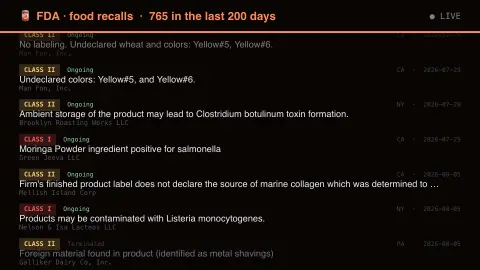
The Pulled From the Shelves screensaver shows food recalls and enforcement reports from openFDA, key-less. Classification is the whole story of a row, and status matters too — a terminated recall from last month is history, not a warning. It's free, runs in your browser, and ESC exits.
Live preview
Press ESC to leave fullscreen. Settings are saved in your browser only.
How the Pulled From the Shelves screensaver works
The saver reads the source described above and draws it on a canvas — no account, no tracking.
Food recalls and enforcement reports from openFDA, key-less. Classification is the whole story of a row, and status matters too — a terminated recall from last month is history, not a warning.
It refreshes on a schedule, so what you see stays current.
Colours and any options can be changed in settings; nothing is stored beyond your own browser.
How FDA food recalls are classified
When a food product is recalled in the United States, the FDA records it in its enforcement reports, which are available through openFDA. Recalls may be conducted on a firm’s own initiative, by FDA request, or by FDA order, and the FDA classifies each recalled product according to the level of hazard involved. The openFDA data is updated weekly, once recalls are classified and appear in the weekly Enforcement Report.
The classification is defined by potential harm. Class I means there is a reasonable probability that using or being exposed to the product will cause serious adverse health consequences or death. Class II covers temporary or medically reversible effects, or cases where serious harm is remote. Class III covers products unlikely to cause adverse health consequences. That is why the class is the most informative field in a row.
Status also matters. A recall is terminated when the FDA determines that all reasonable efforts have been made to remove or correct the product, so a terminated entry is closed history rather than an active alert. A report is administrative information, not a warning for the current moment, and the listing may not name every brand or store. To check a product at home, use the official FDA recall notices.
A worked example
Food recalls and enforcement reports from openFDA, key-less. Classification is the whole story of a row, and status matters too — a terminated recall from last month is history, not a warning.
Settings & tips
- Accent and Background recolour the display.
- Every value on screen comes from the live source — nothing is simulated.
- Press ESC to leave fullscreen.
Frequently asked questions
- Is this real data?
- Yes — it comes from the source named on this page and is refreshed on a schedule.
- Is a key needed?
- No. This source is fully key-less.
- Is it free?
- Yes, and it runs entirely in your browser.
- What is the difference between Class I, II and III?
- They rank potential harm. Class I means a reasonable probability of serious harm or death, Class II means temporary or reversible harm or a remote chance of serious harm, and Class III means harm is not likely.
- Are food recalls always mandatory?
- No. The FDA says recalls may be conducted on a firm’s own initiative, by FDA request, or by FDA order under statutory authority.
- What does a terminated recall mean?
- The FDA has determined that all reasonable efforts have been made to remove or correct the product, so the recall is closed and the entry is part of the record rather than an active alert.