Interest on the Debt Screensaver
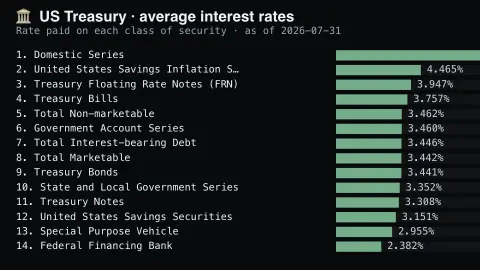
The Interest on the Debt screensaver shows the average interest rate the US Treasury pays on each class of security it has issued, from the Treasury's own key-less FiscalData API. This is the cost of carrying the debt, not the headline debt total. It's free, runs in your browser, and ESC exits.
Live preview
Press ESC to leave fullscreen. Settings are saved in your browser only.
How the Interest on the Debt screensaver works
The saver reads the US Treasury FiscalData API directly in your browser — no key and no account.
The average interest rate the US Treasury pays on each class of security it has issued, from the Treasury's own key-less FiscalData API.
It refreshes on a schedule, so what you see stays current.
Colours can be changed in settings; nothing is stored beyond your own browser.
What average interest rates on the debt represent
Treasury’s FiscalData service publishes a dataset called Average Interest Rates on U.S. Treasury Securities, released monthly. It reports an average rate for each kind of security. Marketable securities, which can be sold on the secondary market, include bills, notes, bonds, Treasury Inflation-Protected Securities (TIPS), floating rate notes and Federal Financing Bank securities. Non-marketable ones, which cannot be transferred or sold that way, include U.S. savings securities, State and Local Government Series and Government Account Series.
Each figure is an average across everything of that kind that is still outstanding, not only what the Treasury borrowed recently. FiscalData describes the calculation as aggregate interest payments divided by total debt, and notes that the total rates exclude TIPS and floating rate notes. Because older debt keeps the rate it was issued at until it matures, a change in market rates feeds through to these averages gradually, as old debt is repaid and new debt is issued.
The figure is a cost per dollar borrowed, so the total interest bill depends on the amount of debt outstanding as well as on the average rate. These are accounting averages, not predictions, and the categories differ in size, so a low rate on a small class says little about the whole. They are not a policy judgement.
A worked example
The average interest rate the US Treasury pays on each class of security it has issued, from the Treasury's own key-less FiscalData API. This is the cost of carrying the debt, not the headline debt total.
Settings & tips
- Accent and Background recolour the display.
- Data comes straight from the US Treasury FiscalData API in your browser.
- Press ESC to leave fullscreen.
Frequently asked questions
- Is this real data?
- Yes — it comes from the US Treasury FiscalData API and is refreshed on a schedule.
- Is a key needed?
- No. This source is fully key-less.
- Is it free?
- Yes — free, no download, in your browser.
- Why does the average rate move slowly?
- It averages all outstanding securities, including older ones issued at earlier rates, so only the portion that is replaced reflects current market levels.
- What is the difference between marketable and non-marketable securities?
- Marketable securities, such as bills, notes and bonds, can be transferred and sold on the secondary market. Non-marketable ones, such as savings securities, cannot.
- Does this show the total interest the government pays?
- No. Total interest depends on both the average rate and the amount of debt, and this display covers rates rather than dollar totals.