Treasury Auctions Screensaver
The Treasury Auctions screensaver shows every US Treasury security as it goes to auction, from the Treasury's own key-less FiscalData API: the term, the CUSIP, and the dates it is issued and matures. It's free, runs in your browser, and ESC exits.
Live preview
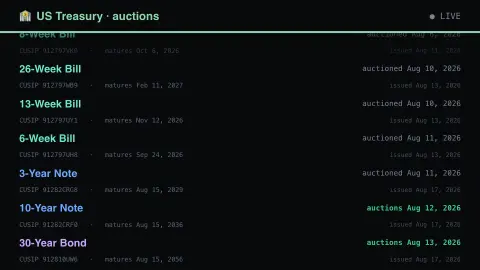
Press ESC to leave fullscreen. Settings are saved in your browser only.
How the Treasury Auctions screensaver works
The saver reads the US Treasury FiscalData API directly in your browser — no key and no account.
Every US Treasury security as it goes to auction, from the Treasury's own key-less FiscalData API: the term, the CUSIP, and the dates it is issued and matures..
It refreshes on a schedule, so what you see stays current.
Colours can be changed in settings; nothing is stored beyond your own browser.
How the Treasury sells its debt
When the United States government spends more than it collects, the Treasury borrows by selling securities at public auction. Bills are short-term, with terms from 4 to 52 weeks. Notes are issued for 2, 3, 5, 7 or 10 years, and bonds have the longest terms, 20 years or more. There are also two-year floating rate notes, whose interest follows 13-week bill rates, and TIPS, whose principal adjusts with the Consumer Price Index.
Each security has a CUSIP, a nine-character code used to identify North American securities for clearing and settlement. The system is owned by the American Bankers Association and operated by CUSIP Global Services. Treasury auctions are single-price: noncompetitive bids are accepted first, then competitive bids from the lowest rate upward until the offering is filled, and every winner gets the rate of the last accepted competitive bid.
Individuals buying through TreasuryDirect bid noncompetitively, accepting whatever rate the auction sets, while competitive bids go through a bank, broker or dealer. The issue date is when the security is delivered and paid for, and the maturity date is when the Treasury repays the principal. An auction record describes an issue, not the state of the economy, and the listing mixes concluded auctions with scheduled ones.
A worked example
Every US Treasury security as it goes to auction, from the Treasury's own key-less FiscalData API: the term, the CUSIP, and the dates it is issued and matures.
Settings & tips
- Accent and Background recolour the display.
- Data comes straight from the US Treasury FiscalData API in your browser.
- Press ESC to leave fullscreen.
Frequently asked questions
- Is this real data?
- Yes — it comes from the US Treasury FiscalData API and is refreshed on a schedule.
- Is a key needed?
- No. This source is fully key-less.
- Is it free?
- Yes — free, no download, in your browser.
- What is a CUSIP?
- A nine-character code that identifies a North American security for clearing and settlement. The first six characters identify the issuer, the next two the issue, and the last is a check digit.
- What is the difference between issue date and maturity date?
- The issue date is when the security is delivered and paid for. The maturity date is when the Treasury repays the face value.
- What is the difference between bills, notes and bonds?
- They differ by term. Bills run from 4 to 52 weeks, notes from 2 to 10 years, and bonds are the longest, at 20 years or more.