Who Reports Releasing Chemicals Screensaver
The Who Reports Releasing Chemicals screensaver shows facilities in the EPA's Toxics Release Inventory, key-less from Envirofacts. This is who reports, not who pollutes most: a facility appears because it crosses a reporting threshold, and the quantities live in a separate dataset. It's free, runs in your browser, and ESC exits.
Live preview
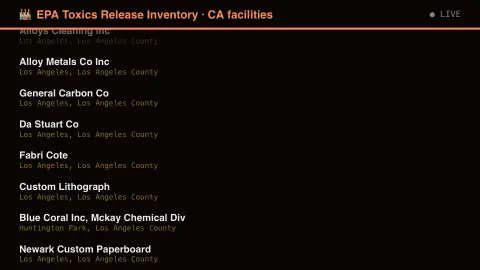
Press ESC to leave fullscreen. Settings are saved in your browser only.
How the Who Reports Releasing Chemicals screensaver works
The saver reads the source described above and draws it on a canvas — no account, no tracking.
Facilities in the EPA's Toxics Release Inventory, key-less from Envirofacts. This is who reports, not who pollutes most: a facility appears because it crosses a reporting threshold, and the quantities live in a separate dataset.
It refreshes on a schedule, so what you see stays current.
Colours and any options can be changed in settings; nothing is stored beyond your own browser.
What the Toxics Release Inventory covers
The Toxics Release Inventory was created by Congress in 1986 under the Emergency Planning and Community Right-to-Know Act, following the 1984 chemical release at Bhopal, India and a 1985 serious release at a similar plant in West Virginia. It gives communities public information on what chemicals nearby industry handles.
Facilities in covered industry sectors that handle listed chemicals above set levels must report to the EPA each year, collected every July. For each chemical they report how much was released to the environment or managed through recycling, energy recovery and treatment. The list covers 810 individual chemicals and 34 chemical categories, which is not every toxic chemical in use.
The saver reads facility records through Envirofacts, the EPA’s public data service. A row identifies a facility by name and location, and it is on the list because it filed, not because of the size of any release; the quantities are held in separate tables and are self-reported. Industry sectors outside the covered list, facilities below the reporting levels and mobile sources such as cars are not included, so it is not a complete census of pollution. A facility’s appearance does not imply a violation of any rule.
A worked example
Facilities in the EPA's Toxics Release Inventory, key-less from Envirofacts. This is who reports, not who pollutes most: a facility appears because it crosses a reporting threshold, and the quantities live in a separate dataset.
Settings & tips
- State changes what the saver shows.
- Accent and Background recolour the display.
- Every value on screen comes from the live source — nothing is simulated.
- Press ESC to leave fullscreen.
Frequently asked questions
- Is this real data?
- Yes — it comes from the source named on this page and is refreshed on a schedule.
- Is a key needed?
- No. This source is fully key-less.
- Is it free?
- Yes, and it runs entirely in your browser.
- Does being listed mean a facility is polluting illegally?
- No. Listing means a facility reported under the programme. The inventory is a disclosure programme and does not itself assess compliance.
- Why does the data lag?
- Facilities report annually, with data collected each July for the previous year, and the EPA publishes it after collection. So the public data always describes a year that has already ended.
- Does a bigger release mean more risk?
- Not necessarily. Toxicity, the form of the chemical and how it reaches people all matter, so quantity alone does not measure health effect.