Reported About Tobacco Screensaver
The Reported About Tobacco screensaver shows tobacco product problem reports, key-less from openFDA. Unusual in that the public files them directly, which produces medical vocabulary beside plain accounts of devices that failed. Reports where a non-user was harmed are marked. It's free, runs in your browser, and ESC exits.
Live preview
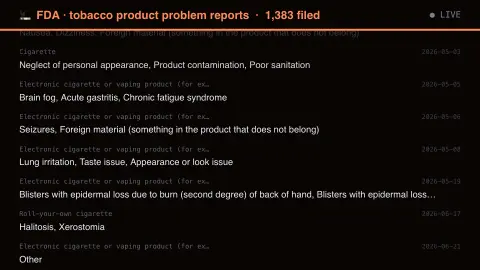
Press ESC to leave fullscreen. Settings are saved in your browser only.
How the Reported About Tobacco screensaver works
The saver reads the source described above and draws it on a canvas — no account, no tracking.
Tobacco product problem reports, key-less from openFDA. Unusual in that the public files them directly, which produces medical vocabulary beside plain accounts of devices that failed. Reports where a non-user was harmed are marked.
It refreshes on a schedule, so what you see stays current.
Colours and any options can be changed in settings; nothing is stored beyond your own browser.
How tobacco problem reports are collected
The FDA accepts reports of problems with tobacco products through its Safety Reporting Portal, which anyone can use. According to openFDA, consumers, manufacturers and health professionals submit reports about products that are damaged, defective or contaminated, smell or taste wrong, or cause undesirable health effects. openFDA converts the data to JSON, covers 2017 onward and updates it quarterly.
Because the public writes much of the text, the entries are uneven. One report may use clinical terms such as chest pain or nausea, another simply says that a battery got hot or a device leaked. openFDA notes that FDA posts the information directly from submitted reports without editing, and that only initial reports are posted, even though submitters may later update theirs.
These are unverified accounts. openFDA warns that submitted information may be inaccurate or incomplete, that reporting is voluntary, and that FDA has not determined causality: inclusion does not mean the product caused the experience. The data cannot be used to estimate risk or incidence rates or to compare products, which makes it useful for spotting patterns but not for measuring risk.
A worked example
Tobacco product problem reports, key-less from openFDA. Unusual in that the public files them directly, which produces medical vocabulary beside plain accounts of devices that failed. Reports where a non-user was harmed are marked.
Settings & tips
- Accent and Background recolour the display.
- Every value on screen comes from the live source — nothing is simulated.
- Press ESC to leave fullscreen.
Frequently asked questions
- Is this real data?
- Yes — it comes from the source named on this page and is refreshed on a schedule.
- Is a key needed?
- No. This source is fully key-less.
- Is it free?
- Yes, and it runs entirely in your browser.
- Are these reports checked by the FDA?
- No. openFDA says the information is posted directly from the submitted reports without editing, does not reflect FDA analysis, and may be inaccurate or incomplete.
- Who can submit a report?
- Anyone can report a problem through FDA’s Safety Reporting Portal. openFDA lists consumers, manufacturers and health professionals among the submitters.
- Do the counts show how dangerous a product is?
- No. openFDA says the data cannot be used to estimate risk or incidence rates, or to compare products, and that inclusion does not mean the product caused the problem.