Biology as Equations Screensaver
The Biology as Equations screensaver shows a rotating draw from EMBL-EBI's BioModels, key-less. Each entry is a working simulation of something alive. The window is randomised rather than sorted: BioModels ids are not chronological, so sorting by id would look meaningful and mean nothing. It's free, runs in your browser, and ESC exits.
Live preview
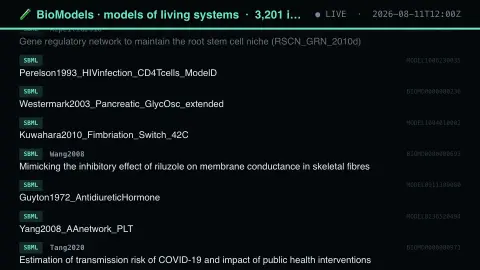
Press ESC to leave fullscreen. Settings are saved in your browser only.
How the Biology as Equations screensaver works
The saver reads the source described above and draws it on a canvas — no account, no tracking.
A rotating draw from EMBL-EBI's BioModels, key-less. Each entry is a working simulation of something alive. The window is randomised rather than sorted: BioModels ids are not chronological, so sorting by id would look meaningful and mean nothing.
It refreshes on a schedule, so what you see stays current.
Colours and any options can be changed in settings; nothing is stored beyond your own browser.
What a BioModels entry contains
BioModels is a repository hosted by EMBL-EBI that stores mathematical models of biological processes, from enzyme pathways and gene-regulation circuits to the spread of a signal through a cell. Most are written in SBML, the Systems Biology Markup Language, an XML format that lets different software tools load and simulate the same model. Many encode a set of reactions as differential equations describing how quantities change over time.
Identifiers reveal how an entry was handled. Manually curated models, which curators check against the publication they come from, have BIOMD identifiers, whereas models that have not been curated have MODEL ones; some of those cannot be curated at all, for instance spatial or steady-state models. Model names often point to the source paper, for example an author, a year and a topic such as a folate-cycle model.
A model is a simplified abstraction. Its value depends on the assumptions and parameters taken from experiments, and it describes a particular system under particular conditions, not biology in general. Entries are drawn from a random starting point, so the ordering has no meaning. A listing here shows that a model exists and can be run; it does not guarantee that its predictions are right.
A worked example
A rotating draw from EMBL-EBI's BioModels, key-less. Each entry is a working simulation of something alive. The window is randomised rather than sorted: BioModels ids are not chronological, so sorting by id would look meaningful and mean nothing.
Settings & tips
- Accent and Background recolour the display.
- Every value on screen comes from the live source — nothing is simulated.
- Press ESC to leave fullscreen.
Frequently asked questions
- Is this real data?
- Yes — it comes from the source named on this page and is refreshed on a schedule.
- Is a key needed?
- No. This source is fully key-less.
- Is it free?
- Yes, and it runs entirely in your browser.
- What does SBML stand for?
- Systems Biology Markup Language, a standard file format for describing models of biological systems so they can be shared between software tools.
- What is the difference between BIOMD and MODEL ids?
- BIOMD identifiers go to curated models, which curators have checked against the source publication. MODEL identifiers are for submissions that have not been curated.
- Can these models be simulated?
- Yes, SBML models can be loaded into simulation software and run, though some need specific tools or parameters to reproduce the published behaviour.