Sun Sign Dial Screensaver
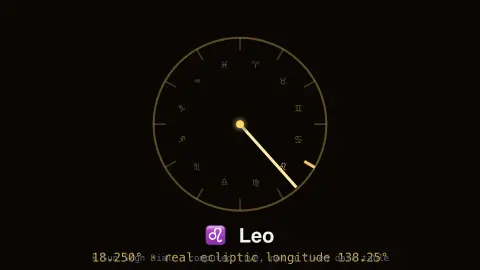
The Sun Sign Dial screensaver points a live gauge at the Sun's real current zodiac position. It is free, runs in your browser, and ESC exits.
Live preview
Press ESC to leave fullscreen. Settings are saved in your browser only.
How the Sun Sign Dial screensaver works
The saver computes the Sun's real geocentric ecliptic longitude for right now.
The dial needle points to that real degree around the 360° zodiac wheel.
The current sign and exact degree are read directly off that computation.
Everything is computed locally — no network, no key.
Why the Sun has a position on the zodiac
The ecliptic is the path the Sun appears to trace across the sky over a year, which is really the plane of Earth’s orbit seen from Earth. Astronomers measure position along it by ecliptic longitude, from 0° to 360°, counted eastward from the direction of the March equinox. The tropical zodiac used in Western astrology divides this circle into twelve 30-degree signs, starting at that equinox point.
The dial shows the Sun’s apparent longitude at this moment, which is why it creeps steadily around instead of jumping once a month. Because Earth’s orbit is slightly elliptical and perihelion falls in early January, the Sun moves a little faster in northern winter than in summer. The astronomical seasons show it: winter, from the December solstice to the March equinox, lasts about 89 days, while summer lasts about 93.6, so signs do not last exactly the same number of days.
The tropical zodiac is tied to the equinoxes and seasons, whereas the constellations that share the sign names have drifted relative to it because of axial precession, the slow change in the orientation of Earth’s axis. The sign the Sun is in therefore does not generally match the constellation behind it.
A worked example
Near a sign boundary, the real computed degree — not a fixed calendar date — decides which sign the dial shows.
Settings & tips
- Each zodiac sign spans exactly 30° of the real ecliptic.
- Accent recolours the dial needle and readout.
- This is more precise than a fixed month-day boundary table.
Frequently asked questions
- Is this more accurate than a calendar table?
- Yes — it uses the Sun's real computed ecliptic degree rather than fixed calendar dates.
- How is the Sun's position computed?
- From Earth's real heliocentric orbital position, converted to geocentric solar longitude.
- Is a key needed?
- No. Everything is computed locally in your browser.
- Is it free?
- Yes — free, no download, in your browser.
- Is the Sun really in the constellation of its sign?
- Not generally. Axial precession has shifted the equinox points relative to the stars, so the tropical signs no longer line up with the constellations that gave them their names.
- Why are signs not exactly the same length in days?
- Each sign spans 30 degrees of longitude, but the Sun moves at slightly different speeds around the year because Earth’s orbit is elliptical, with perihelion in early January. Signs in northern winter pass a bit more quickly.
- What is the exact degree on the dial?
- It is the Sun’s ecliptic longitude, with 0 degrees at the March equinox. The degree within the sign is the position past its starting boundary, from 0 to 30.