Stopwatch Screensaver
The Stopwatch screensaver counts up from zero in a large glowing display, showing minutes, seconds and hundredths, with lap splits you can record. It measures elapsed time against your device's own clock, so the timing stays accurate. It runs free in your browser with no download, and ESC exits.
Live preview
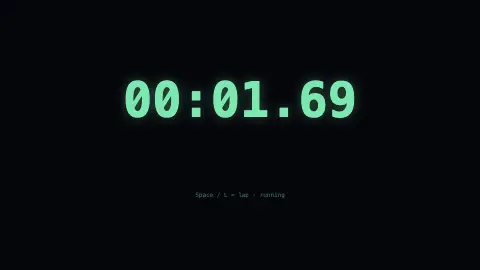
Press ESC to leave fullscreen. Settings are saved in your browser only.
How the Stopwatch screensaver works
When it starts, the saver stores the current moment and then updates about 30 times a second, subtracting the start time from the current time on each frame. That elapsed total is formatted into hours, minutes, seconds and hundredths.
Because it measures against your device clock rather than counting frames, the elapsed time is real-time accurate even if the browser briefly stutters - it always reflects the true gap since you started.
Press Space or L to record a lap. The saver captures both the split (time since the last lap) and the running total, lists the most recent laps newest-first, and keeps the last six on screen.
An optional auto-lap can mark a lap automatically at a fixed interval, so you get regular splits without touching the keyboard.
Timing, laps and splits explained
A stopwatch measures an interval, not a time of day. An early timing instrument built for horse racing was Nicolas Mathieu Rieussec's inking chronograph of about 1821, in which a stylus left a mark on a rotating disc when activated. Later mechanical chronographs added resettable hands and split-seconds mechanisms, and digital timers eventually replaced them. Software versions rely on the computer's clock instead of a spring or a crystal.
The lap and split distinction trips people up. A lap time is the duration of one segment, from the last lap mark to this one, while the split, or cumulative time, is the running total since the start. Runners and swimmers use laps to see whether their pace is steady, and a coach reading splits can tell whether the second half of a race was faster or slower than the first.
On a computer, precision depends on how finely the system reports time and how often the screen redraws. Hundredths of a second are displayed, but a person pressing a key adds a delay, so a hand-timed result carries a fraction of a second of uncertainty at both start and stop. Official races use electronic timing with sensors, which is far more precise than anyone pressing a button.
A worked example
Settings & tips
- Press Space or L any time to record a lap split while the stopwatch runs.
- Set Auto-lap every to a number of seconds to drop regular splits hands-free, or leave it at 0 to lap manually.
- Turn off Show laps for a clean count-up display with no lap list underneath.
Frequently asked questions
- How do I record a lap on the stopwatch?
- Press Space or the L key while the stopwatch is running. It records the split since your last lap and the running total, keeping the most recent laps on screen newest-first.
- Is the stopwatch screensaver accurate?
- Yes. It measures elapsed time against your device's own clock rather than counting frames, so the time is real-time accurate even if the browser briefly stutters.
- Can the stopwatch lap automatically?
- Yes. Set Auto-lap every to a number of seconds and it records a split at that interval without any key presses. Leave it at 0 to lap only by hand.
- Does the stopwatch show hundredths of a second?
- Yes. The big readout counts up in minutes, seconds and hundredths, and adds an hours field once the time passes one hour.
- Is the stopwatch screensaver free?
- Yes. It runs entirely in your browser with no download or account. Press ESC whenever you want to exit full screen.
- What is the difference between a split and a lap?
- A lap is the time for one section, while a split is the total elapsed time at that point. If laps are 30, 31 and 29 seconds, the splits are 30, 61 and 90.
- How accurate is a software stopwatch?
- The clock it reads is very accurate, but your own reaction time in starting and stopping it adds an error of a fraction of a second.
- Why did stopwatches matter historically?
- Measuring short intervals precisely mattered for horse racing, where early chronographs such as Rieussec's were built, and later for athletics, where fair timing made results comparable.