Stock-to-Flow Model Screensaver
The Stock-to-Flow Model screensaver compares Bitcoin's real live price and real current circulating supply against the stock-to-flow scarcity model — a popular, unofficial and genuinely contested framework. It's free, runs in your browser, and ESC exits.
Live preview
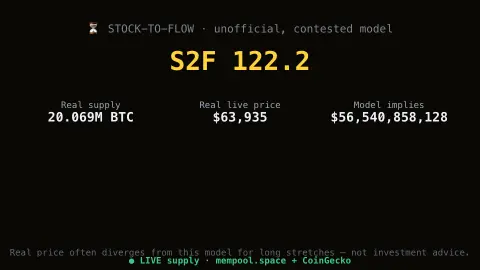
Press ESC to leave fullscreen. Settings are saved in your browser only.
How the Stock-to-Flow Model screensaver works
The saver computes Bitcoin's real current circulating supply from the live block height via mempool.space.
Stock-to-flow — supply divided by annual issuance — is calculated from that real, exact figure.
The model's real published formula projects a value from that ratio, shown beside the real live price.
Both update live as new blocks and price ticks arrive.
Stock-to-flow: scarcity as a price model
Stock-to-flow is a ratio borrowed from commodity analysis. The stock is the existing supply and the flow is the amount newly produced in a year, so a high ratio means new production is small compared with what already exists. Gold is often cited as a high stock-to-flow asset for that reason. Applied to Bitcoin, the ratio rises each time the block reward halves, which happens every 210,000 blocks, roughly every four years, as part of the protocol's design.
In 2019 an analyst using the pseudonym PlanB published a model that fits Bitcoin's price to this ratio, and it became widely discussed. The model is a statistical fit over a short history with only a few halving cycles. Critics argue that two trending series can look correlated without any causal link, and that it leaves out demand, regulation and sentiment. Supporters argue that scarcity is a real driver of value.
The supply figure itself is not in dispute: it follows from the block height and the issuance schedule, which starts at 50 BTC per block and halves every 210,000 blocks. Coins whose keys are lost still count in that total even though they can never be spent. The valuation is where opinion enters, and this display shows a model alongside a market price for comparison only. It is not a forecast or financial advice.
A worked example
After a halving, the real stock-to-flow ratio roughly doubles overnight — issuance is cut in half by design, a real, scheduled scarcity event, not a market move.
Settings & tips
- Accent recolours the comparison gauge.
- This model has real, publicly documented critics as well as proponents — it's shown as one framework, not a prediction.
- Supply and issuance figures are exact and computed from real block height.
Frequently asked questions
- Is stock-to-flow reliable?
- It's a genuinely contested model — real critics have pointed out real periods where price diverged sharply from it. Shown here as one popular framework, not investment advice.
- Is a key needed?
- No. Supply comes from mempool.space and price from CoinGecko, both free and key-less.
- What is stock-to-flow?
- A scarcity ratio — existing supply divided by new annual production — borrowed from commodities analysis and applied to Bitcoin's real, known issuance schedule.
- Is it free?
- Yes — free, no download, in your browser.
- What is a Bitcoin halving?
- It is a scheduled event, every 210,000 blocks (roughly every four years), in which the reward for creating a block is cut in half. It reduces the rate at which new coins are issued.
- Can supply be known exactly?
- The issuance schedule is fixed by protocol rules, so the total coins created follow directly from block height. Coins whose keys are lost are not subtracted, so the spendable supply in practice is lower.
- Why do critics doubt the model?
- It fits only a handful of halving cycles and treats a correlation as a cause. With so few data points it is hard to separate the model from coincidence.