Star Swarm Screensaver
Star Swarm is a self-playing arcade screensaver inspired by the 1981 formation shooter. Aliens fly in along curved paths into formation, then peel off in dive-bomb runs while a gunner picks them off. It's a free, original homage, runs in your browser, and ESC exits.
Live preview
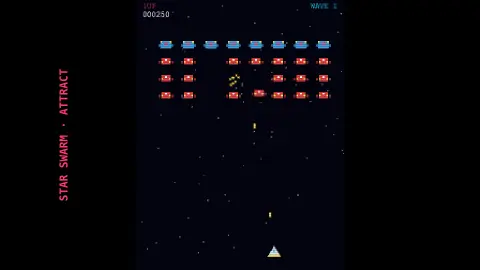
Press ESC to leave fullscreen. Settings are saved in your browser only.
How the Star Swarm screensaver works
Star Swarm is an original tribute to the formation-flying fixed shooter — original art and name throughout.
Each wave's aliens fly in along sweeping curved paths and settle into a grid formation at the top.
From there they peel off one at a time in dive-bomb runs, swooping across the screen and dropping fire.
A self-playing gunner at the base tracks the divers, fires upward, and clears the wave to summon the next.
The formation shooter and its dive-bombers
Fixed shooters keep the player's ship on a single axis at the bottom of the screen while enemies move above. The genre was defined by Taito's Space Invaders in 1978, in which a rigid grid of aliens marches down the screen. Namco's Galaxian followed in 1979, and its formation aliens dived down toward the player while shooting, which changed the feel from attrition to constant threat. Namco's Galaga, released in 1981, kept the diving attacks and added a tractor-beam mechanic that could capture the player's ship.
The curved entrances common to this style are typically drawn from parametric curves such as splines and Bezier curves, which let a designer describe a smooth sweep with a few control points. Enemies follow a path as a function of time, so a wave can be choreographed precisely. Once settled in the grid, individual ships break away and follow a separate curve toward the player.
Star Swarm is original work inspired by this style, with its own artwork and name, and it is not the commercial arcade title. The self-playing gunner in attract mode exists so the screen looks lively; it has no relation to actual scores. Studying the genre is also a way to see how a small set of movement rules creates the sense of an intelligent swarm.
A worked example
A squadron loops in along curving trails into a neat formation; one alien peels off and dive-bombs, the gunner slides under it and fires, the alien bursts, and the swarm sways overhead waiting its turn to swoop.
Settings & tips
- It runs in attract mode — the gunner aims and fires on its own.
- Watch the curved fly-in paths as each wave forms up.
- Aliens are most dangerous mid-dive, away from the formation.
Frequently asked questions
- Is this Galaga?
- No. It's an original homage inspired by the 1981 formation shooter, with its own art and name — nothing copyrighted is copied.
- Can I play it myself?
- Right now it runs in self-playing attract mode, like an arcade demo screen. A keyboard-playable mode may be added later.
- Does it need a connection?
- No. It's computed entirely on your device, so it runs fully offline.
- Why do the aliens fly in curves?
- The sweeping entry paths and dive-bomb arcs are what gave the original its signature feel, recreated here in motion.
- Is it free?
- Yes — free, no download, in your browser.
- How do enemies follow curved paths?
- Typically each path is defined by control points of a spline or Bezier curve, and the enemy's position is computed along it as time advances. The same idea animates cameras and vehicles in many games.
- Why do formation shooters feel different from earlier ones?
- Because enemies leave the grid and attack individually, the player has to dodge as well as shoot. That mix of pattern and unpredictability was a notable design step.
- What is a fixed shooter?
- It is a shooting game where the player's movement is limited to a fixed line or area while the screen does not scroll. It contrasts with scrolling shooters where the background moves.