Silo Defense Screensaver
The Silo Defense screensaver is a self-playing, attract-mode tribute to the classic missile-defense arcade genre, with an AI defender intercepting incoming missiles. It is free, runs in your browser, and ESC exits.
Live preview
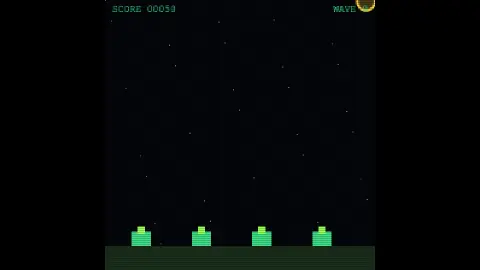
Press ESC to leave fullscreen. Settings are saved in your browser only.
How the Silo Defense screensaver works
A self-playing crosshair traces trails across the sky, launching interceptors at incoming missiles.
Missiles streak down toward a row of silos; successful intercepts detonate in an expanding blast radius.
The pace gradually escalates, exactly like the arcade original's wave-based difficulty curve.
All art and names here are original, in the spirit of the genre rather than a copy of any one game.
The Missile Command lineage
Silo Defense takes its cue from Missile Command, released by Atari as an arcade game in 1980 and designed by Dave Theurer. You defend six cities from incoming missiles using three missile batteries, each holding ten counter-missiles, and a trackball that moves the crosshair. Theurer insisted that no countries be named and that the player could only defend, never retaliate.
The mechanic is more subtle than shooting. A counter-missile does not hit anything directly; it bursts at the crosshair and leaves a fireball that lasts several seconds, and enemy missiles and craft that enter the fireball are destroyed. Skilled play is about leading targets, timing bursts and saving ammunition, since each battery holds a fixed stock.
Later waves bring missiles that split into multiple warheads, smart bombs that can dodge imprecisely aimed shots, and bombers and satellites that launch missiles of their own. The game cannot be won: when the last city falls, the screen reads “The End” instead of “Game Over”. The self-playing defender here follows the same logic rather than reproducing the original code, and all art and names are original to this site.
A worked example
An incoming missile trail is intercepted just before reaching a silo, its blast radius catching two more missiles in the same wave.
Settings & tips
- Accent recolours the interceptor blasts.
- Runs in self-playing attract mode, like a classic arcade cabinet's demo screen.
- Original art and names — an homage, not a copy.
Frequently asked questions
- Can I play this myself?
- It runs in self-playing attract mode, like a classic arcade cabinet between games.
- Is this an official game?
- No — it is an original tribute inspired by the classic missile-defense arcade genre.
- Is a key needed?
- No — it runs entirely locally.
- Is it free?
- Yes — free, no download, in your browser.
- Why do the explosions matter more than the missiles?
- Interceptors only act through their blast, so the skill is placing a fireball where a warhead will be, not hitting it directly.
- Who designed the original Missile Command?
- Dave Theurer designed it for Atari, and the arcade game appeared in 1980.
- Can the original game be won?
- No. It ends when all cities are destroyed, and it shows “The End” rather than “Game Over”.