Cube Hopper Screensaver
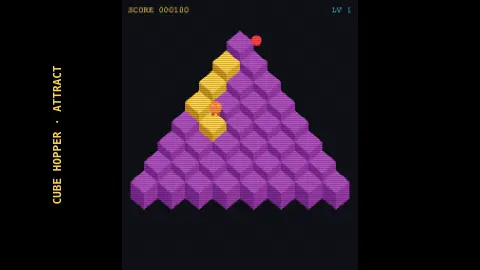
Cube Hopper is a self-playing arcade screensaver inspired by the 1982 isometric hopper. A character bounces a pyramid of cubes, flipping each to the target colour while dodging falling foes. It's a free, original homage, runs in your browser, and ESC exits.
Live preview
Press ESC to leave fullscreen. Settings are saved in your browser only.
How the Cube Hopper screensaver works
Cube Hopper is an original tribute to the isometric cube-hopping classic — original art and name throughout.
A pyramid of cubes is drawn in a 3-D isometric view, seven rows tall.
The hopper plays itself, bouncing diagonally from cube to cube; each one it lands on flips to the target colour.
Foes tumble down the pyramid too — a wrong hop off the edge, or a collision, sends the hopper back to the top.
The isometric trick behind a 1982 pyramid game
The arcade game behind this screensaver, Q*bert, was released by Gottlieb in 1982. It was designed by Jeff Lee and Warren Davis, with Lee conceiving the game and its title character and Davis developing it. The player guides an orange, armless creature with a tubular nose around a pyramid of 28 cubes, changing every cube to a target colour by hopping on it while enemies chase it. Its controller was a four-way joystick mounted diagonally, rotated 45 degrees to match the character's diagonal hops.
The look comes from isometric projection, a way of drawing three-dimensional objects in which the three main axes are shown at equal angles to the viewer, with no vanishing point. Each cube therefore appears as a hexagon made of three rhombi, and a hop between neighbouring cubes becomes a diagonal move on screen. Because the projection keeps lengths consistent, a pyramid of identical cubes stacks neatly in the drawing.
Cube Hopper uses its own art and names but keeps the diagonal movement and the seven-row pyramid. Much of the challenge in such games is spatial: seeing which cube is on which row and where a hop will land when the picture is flat.
A worked example
The hopper bounces down-left, down-right, each cube flashing to gold as it lands; a red foe tumbles down one side, the hopper veers away, and the last grey cube flips — the pyramid complete — before a fresh, faster board begins.
Settings & tips
- It runs in attract mode — the hopper bounces on its own.
- Each cube flips colour the first time the hopper lands on it.
- Hopping off the edge of the pyramid sends it back to the top.
Frequently asked questions
- Is this Q*bert?
- No. It's an original homage inspired by the 1982 isometric hopper, with its own art and name — nothing copyrighted is copied.
- Can I play it myself?
- Right now it runs in self-playing attract mode, like an arcade demo screen. A keyboard-playable mode may be added later.
- Does it need a connection?
- No. It's computed entirely on your device, so it runs fully offline.
- What's the goal?
- Flip every cube on the pyramid to the target colour by hopping on it, while avoiding the foes — then the level resets faster.
- Is it free?
- Yes — free, no download, in your browser.
- What is isometric projection?
- It is a method of drawing three-dimensional objects with the three axes at equal angles and without perspective, so parallel edges stay parallel and lengths stay consistent.
- Why do the hops go diagonally?
- In an isometric view the grid is rotated, so each cube's neighbours lie along the diagonals of the screen. A hop to a neighbour therefore appears as a diagonal move. The original arcade game even mounted its joystick diagonally to match.
- Who made the original game?
- Q*bert was released by Gottlieb in 1982 and designed by Jeff Lee and Warren Davis. This screensaver is an independent homage with original artwork.