Spaceflight Newswire Screensaver
The Spaceflight Newswire screensaver streams the newest articles from the outlets that cover launches — NASASpaceflight, SpaceNews, Spaceflight Now, Teslarati and others — as one feed, newest first, from an index of some thirty-five thousand articles. It runs in the browser with nothing to install; press ESC to exit.
Live preview
Press ESC to leave fullscreen. Settings are saved in your browser only.
How the Spaceflight Newswire screensaver works
The saver reads The Spaceflight News API, key-free.
No account and no key: the request goes straight from your browser, or from this site's own refreshed copy of the feed where the source does not allow browser access.
Values are drawn on a canvas that resizes with the window, so it works on a laptop or a wall display.
If the source is unreachable the saver says so on screen rather than showing stale numbers as though they were current.
A shared index of spaceflight journalism
The Spaceflight News API is a service that aggregates metadata from spaceflight news sites into one searchable index. Its repository says it pulls from dozens of sites, around 38 at the time of writing, including NASA, ESA, SpaceNews, Space.com and Reuters. It is maintained by The Space Devs, a group of space-enthusiast developers who also run Launch Library 2 and offer data and tools to app developers free of charge.
Each entry points to the original publisher, so the content shown is a title and short summary that sends readers on to the outlet's site. Some publications focus on launch hardware and test campaigns, others on industry and policy or on one company, which gives the combined list a character of its own. The API's documentation also lists endpoints for blogs and reports alongside articles, and the Launch Library 2 integration lets news be tied to a specific launch.
Because the index lists whatever the contributing outlets publish, it reflects what is being covered rather than what is most important. A launch day can flood the list with near-identical stories, while a quiet week may be dominated by commentary. Headlines are written by the outlets themselves.
A worked example
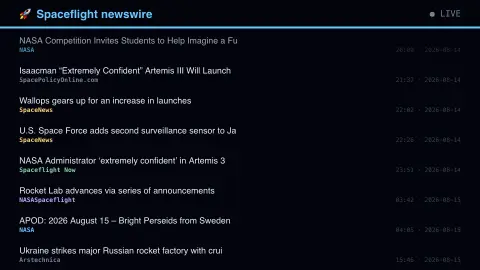
Each row is a headline with its publication colour-coded beneath and the filing time on the right. On an active day the ordering is itself informative: three outlets filing on the same scrub within twenty minutes of each other tells you something happened.
Settings & tips
- Accent and Background recolour the display without changing the data.
- Add it to a Multi-view grid to watch it alongside other live savers.
- Press ESC at any time to leave fullscreen.
Frequently asked questions
- Which outlets does it cover?
- The API aggregates the specialist spaceflight press — NASASpaceflight, SpaceNews, Spaceflight Now, Teslarati, NASA's own releases and a dozen more — rather than general news sites that cover launches occasionally.
- How quickly does it update?
- The feed is fetched every fifteen minutes, and the outlets themselves file within minutes of an event, so a scrub or a successful launch appears quickly.
- Is this real data?
- Yes. It comes from The Spaceflight News API, key-free. Nothing is invented or simulated, and if the source cannot be reached the saver reports that instead of drawing something plausible.
- Does it cost anything or need an account?
- No. Every screensaver here is free, runs in the browser and needs no sign-up. This one uses a public API that requires no key.
- Who runs the Spaceflight News API?
- It is built by The Space Devs, a group of space-enthusiast developers who also run Launch Library 2 and provide spaceflight data and tools to app developers.
- Which sites does it draw from?
- Its repository describes aggregating metadata from about 38 news sites, including NASA, ESA, SpaceNews, Space.com and Reuters. Each item identifies its source.
- Why do several stories about the same launch appear together?
- Different outlets cover the same events, so a launch or test can generate many articles at once.