The Brightest Stars Screensaver
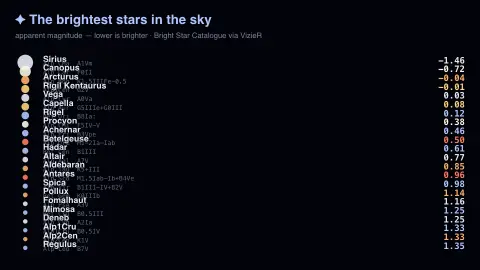
The Brightest Stars screensaver ranks the brightest stars in the sky by apparent magnitude, read live from the Bright Star Catalogue via VizieR at Strasbourg. Magnitude runs backwards — lower is brighter — and the scale is logarithmic, so Sirius at -1.46 is about twenty-five times brighter to the eye than a star at 0.85. It runs in the browser with nothing to install; press ESC to exit.
Live preview
Press ESC to leave fullscreen. Settings are saved in your browser only.
How the The Brightest Stars screensaver works
The saver reads The Bright Star Catalogue (Hoffleit & Jaschek) served by VizieR at the Centre de Données astronomiques de Strasbourg.
No account and no key: the request goes straight from your browser, or from this site's own refreshed copy of the feed where the source does not allow browser access.
Values are drawn on a canvas that resizes with the window, so it works on a laptop or a wall display.
If the source is unreachable the saver says so on screen rather than showing stale numbers as though they were current.
The magnitude scale and the Bright Star Catalogue
The scale astronomers use for star brightness is traditionally traced to Hipparchus, who is credited with sorting naked-eye stars into six classes with the brightest as first magnitude; his own catalogue is lost, and Ptolemy's Almagest popularised the system. In 1856 Norman Pogson made it precise: five magnitudes equal a brightness factor of exactly one hundred, so one step is about 2.512 times. That is why numbers run backwards, and why objects brighter than the zero point have negative values.
The list is drawn from the Bright Star Catalogue, which includes stars of magnitude 6.5 or brighter, roughly every star visible to the naked eye. Frank Schlesinger published the first version in 1930, and the latest edition, from 1991, was compiled and edited by Ellen Dorrit Hoffleit of Yale. It holds 9,110 objects, of which 9,095 are stars. VizieR, run by the Strasbourg astronomical data centre, hosts it as catalogue V/50.
Apparent magnitude is brightness as seen from Earth, which mixes a star's intrinsic luminosity with its distance, so a nearby dim star can outshine a distant luminous one. The magnitudes in the catalogue are visual ones, which can differ from later photoelectric measurements.
A worked example
Each star gets a disc sized by its actual brightness ratio and tinted by spectral class — blue-white for hot O and B stars, yellow for G, orange-red for K and M — with its proper name, Bayer designation, spectral type and magnitude. Sirius leads, then Canopus, Arcturus, Alpha Centauri and Vega.
Settings & tips
- Accent and Background recolour the display without changing the data.
- Add it to a Multi-view grid to watch it alongside other live savers.
- Press ESC at any time to leave fullscreen.
Frequently asked questions
- Does brightest mean biggest or closest?
- Neither. Apparent magnitude is how bright a star looks from Earth, which combines its true luminosity with its distance. Canopus is far more luminous than Sirius and appears dimmer only because it is about nine times further away.
- Is this real data?
- Yes. It comes from The Bright Star Catalogue (Hoffleit & Jaschek) served by VizieR at the Centre de Données astronomiques de Strasbourg. Nothing is invented or simulated, and if the source cannot be reached the saver reports that instead of drawing something plausible.
- Does it cost anything or need an account?
- No. Every screensaver here is free, runs in the browser and needs no sign-up. This one uses a public API that requires no key.
- How much brighter is magnitude 1 than magnitude 6?
- Exactly one hundred times, by the definition of the scale. Each step of one magnitude is a factor of about 2.512.
- Why do some stars have negative magnitudes?
- Zero was set as a reference point, and anything brighter than it gets a negative number. Sirius, the brightest star in the night sky, is about magnitude -1.46.
- Is this the sky as I see it?
- Roughly, for the faintest naked-eye stars, since the catalogue goes down to about magnitude 6.5. City light, haze and altitude change which stars you can actually spot.