Simulated Annealing Optimizer Screensaver
The Simulated Annealing Optimizer screensaver runs a real simulated-annealing algorithm live, improving a random tour by accepting occasional worse moves early and cooling into a refined solution. It is free, runs in your browser, and ESC exits.
Live preview
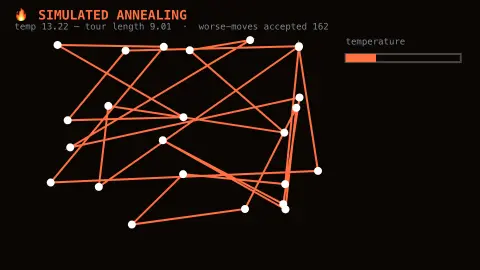
Press ESC to leave fullscreen. Settings are saved in your browser only.
How the Simulated Annealing Optimizer screensaver works
The saver starts with a real random tour through scattered points and a high starting "temperature" parameter.
At each step, a real random tour tweak is proposed; better tweaks are always accepted, and worse ones are accepted with a real probability that shrinks as temperature cools.
This real occasional acceptance of worse moves lets the search escape local dead ends that a strictly-downhill method would get stuck in.
As the real temperature cools toward zero, the tour settles into a genuinely refined, rarely-worsening solution; it holds briefly, then a fresh run begins.
From cooling metal to hard optimisation
Annealing is the old metalworking process of heating a material and cooling it slowly so its atoms settle into a low-energy, orderly arrangement. In 1953 Nicholas Metropolis and colleagues published a Monte Carlo method for sampling the states of a thermodynamic system, and in 1983 Scott Kirkpatrick, Daniel Gelatt and Mario Vecchi adapted it as a general optimisation technique, applying it to the travelling salesman problem and naming it simulated annealing. Vladimír Černý arrived at a similar idea independently in 1985.
The key is the acceptance rule. A move that improves the solution is always taken, while a worse move is taken with probability exp(-Δ/T), where Δ is how much worse it is and T is the temperature. When T is large the search wanders freely and can climb out of poor local optima; as T falls, the process becomes more selective and eventually behaves like pure descent.
The travelling salesman problem, which asks for the shortest closed tour through a set of points, is the standard demonstration, because it is easy to state and hard in general. Simulated annealing is a heuristic: it usually finds a very good tour but gives no practical guarantee of the best one. Convergence to a global optimum has been shown only in the limit of an extended cooling schedule, and the result depends on how slowly the temperature is lowered.
A worked example
Early in the run, the tour visibly jumps to longer, worse configurations now and then; as the real temperature drops, those jumps stop happening and the tour steadily, monotonically improves instead.
Settings & tips
- Accent recolours the current tour.
- The cooling schedule and acceptance rule are real, not scripted.
- A fresh random tour and full cooling schedule begins automatically once it finishes.
Frequently asked questions
- Is this real simulated annealing?
- Yes — a real cooling schedule and real probabilistic acceptance rule, the same core algorithm used in real optimization software.
- Why accept worse solutions sometimes?
- It is a real, deliberate strategy — occasionally accepting worse moves helps the search escape local optima it would otherwise get stuck in.
- Is a key needed?
- No — it is a pure local computation.
- Is it free?
- Yes — free, no download, in your browser.
- What does the temperature mean in the algorithm?
- It is a control parameter, not a physical temperature. It sets how willing the search is to accept a worse solution, high at the start and low at the end.
- Does simulated annealing find the best possible tour?
- Not reliably. It is a heuristic that usually finds a good answer, and slower cooling improves the odds. Guarantees of reaching the global optimum only hold for very long cooling schedules that are rarely practical.
- What else is it used for?
- Problems with a huge space of possible arrangements, where trying them all is impossible. Circuit layout was among the early applications.