Huffman Coding Tree Builder Screensaver
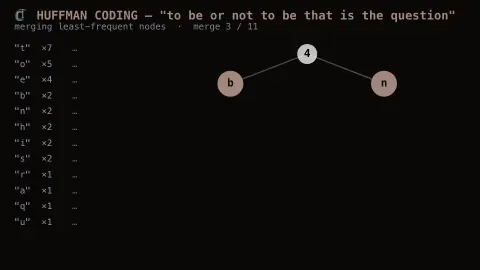
The Huffman Coding Tree Builder screensaver builds a real live Huffman tree from genuine letter frequencies, merging the two least-frequent nodes at each step into optimal codes. It is free, runs in your browser, and ESC exits.
Live preview
Press ESC to leave fullscreen. Settings are saved in your browser only.
How the Huffman Coding Tree Builder screensaver works
The saver counts the real letter frequencies of a random block of text, then creates one leaf node per distinct letter.
At each step, the real two least-frequent nodes are merged into a new parent node whose frequency is their sum, exactly the greedy rule Huffman coding uses.
This repeats until a single root node remains, and each leaf's real code is read off as the path of left/right branches down from the root.
Once the tree completes, the real resulting codes are shown briefly next to each letter, then a fresh random text and tree build begins.
Huffman's exam question that beat Shannon and Fano
In 1951 David Huffman was a student at MIT in an information theory class taught by Robert Fano. Students could choose between a final exam and a term paper on finding the most efficient binary code. Huffman could not prove that any code he tried was the most efficient, but he hit on building a frequency-sorted binary tree from the bottom up, and showed it was optimal. He published it in 1952 as A Method for the Construction of Minimum-Redundancy Codes. It beat the top-down Shannon-Fano approach.
The construction is greedy: repeatedly take the two least frequent items and merge them into one, until a single tree remains, then read each symbol's code from the path of left and right turns. The codes are prefix-free, meaning no code is the start of another, so a stream of bits can be decoded unambiguously without separators. Frequent symbols end up near the top and get short codes, rare ones sit deep and get long codes.
For coding each symbol separately with a known distribution, Huffman's method is optimal; arithmetic coding often compresses better. Prefix codes remain popular for their simplicity and speed, and serve as a back end in Deflate and JPEG, usually with predefined code tables.
A worked example
The most frequent letter in the text ends up with the real shortest code — often just one or two bits — while a rare letter gets a real longer code, exactly the compression trade-off Huffman coding guarantees is optimal.
Settings & tips
- Accent recolours the two nodes currently merging.
- This is a real, correct greedy Huffman coding algorithm.
- A fresh random text and tree build begins automatically once codes are assigned.
Frequently asked questions
- Is this a real compression algorithm?
- Yes — real Huffman coding, still used today inside formats like ZIP, JPEG and MP3.
- Why do common letters get shorter codes?
- It is a real, provably optimal trade-off — assigning shorter codes to frequent symbols minimizes the total encoded length.
- Is a key needed?
- No — it is a pure local computation.
- Is it free?
- Yes — free, no download, in your browser.
- What does prefix-free mean?
- No code word is the beginning of another, so you can read bits one at a time and know exactly where each symbol ends without any separator.
- Where is Huffman coding used today?
- Huffman-style prefix codes are a back-end stage in Deflate (the format behind ZIP and gzip) and in JPEG, usually with predefined code tables.
- Can Huffman coding be beaten?
- Yes. Arithmetic coding often compresses better, because Huffman coding is only optimal when each symbol is coded separately with a known distribution.