Neural Network Forward Pass Screensaver
The Neural Network Forward Pass screensaver runs a real small feedforward neural network live, propagating random inputs through its actual weighted layers. It is free, runs in your browser, and ESC exits.
Live preview
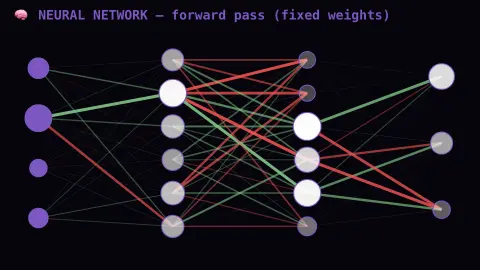
Press ESC to leave fullscreen. Settings are saved in your browser only.
How the Neural Network Forward Pass screensaver works
The saver builds a real small feedforward network with a fixed random set of weights across a few layers of neurons.
A real random input vector feeds into the first layer, and every neuron's activation is genuinely computed as a weighted sum passed through a real activation function.
Each layer's real activation values light up its neurons, and the brightness of each connecting line reflects its real weight and signal strength.
Once the forward pass reaches the output layer, it holds briefly to show the result, then a fresh random input begins propagating.
What happens inside a neural network on a forward pass
A neural network is a stack of layers, each made of simple units loosely inspired by neurons. A unit takes numbers from the previous layer, multiplies each by a stored weight, adds them up with a small offset called a bias, and passes the sum through a non-linear activation function such as ReLU or tanh. The result becomes an input to the next layer. Running an input through all the layers once to produce an output is called a forward pass.
The activation function matters more than it looks. Without it, a stack of layers would collapse into a single linear calculation, no matter how many there were. The non-linearity is what allows deep networks to represent curved, complicated relationships between input and output. The perceptron, an early trainable neural model, was described by Frank Rosenblatt in a 1958 paper in Psychological Review, written at the Cornell Aeronautical Laboratory.
The weights are where everything a network ‘knows’ is stored. In real systems they are set by training, usually with backpropagation, which adjusts them to reduce error on example data. Here the weights are fixed and random, so the output is not a meaningful prediction; the display shows the mechanism of computation, which is identical in structure to what runs inside far larger models.
A worked example
A strongly positive input paired with a strongly positive weight lights a connection brightly, while a negative weight on the same input visibly dims or suppresses the neuron it feeds — real weighted computation, not decoration.
Settings & tips
- Accent recolours the most active neurons.
- The weights and activation function are real, fixed values, not decorative.
- A fresh random input begins propagating automatically each cycle.
Frequently asked questions
- Is this a real neural network?
- Yes — a real small feedforward network with genuine weights and a real activation function, not a stylized animation.
- Does it learn or train?
- No — this shows a real forward pass with fixed weights; it does not adjust weights through training.
- Is a key needed?
- No — it is a pure local computation.
- Is it free?
- Yes — free, no download, in your browser.
- What is a bias in a neuron?
- It is a number added to the weighted sum before the activation function. It lets a unit shift its threshold, so it can activate even when all of its inputs are small or zero.
- Why do networks need an activation function?
- Without a non-linear activation, any number of stacked layers reduces to one linear transformation. The non-linearity gives depth its power to model complex patterns.
- How big are real neural networks?
- Sizes vary enormously, from a handful of weights to very large models with billions of them. Each layer still does the same weighted-sum-and-activation step shown in this small example.