Who Still Buys Savings Bonds Screensaver
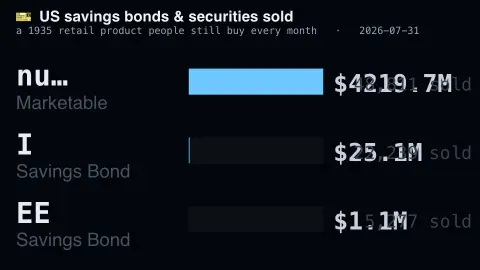
The Who Still Buys Savings Bonds screensaver shows monthly US savings bond and securities sales, key-less from Treasury FiscalData. Filtered to the newest reporting month so the same bond is not counted twice. The I bond count is a rough read on how worried households are about prices. It's free, runs in your browser, and ESC exits.
Live preview
Press ESC to leave fullscreen. Settings are saved in your browser only.
How the Who Still Buys Savings Bonds screensaver works
The saver reads the source described above and draws it on a canvas — no account, no tracking.
Monthly US savings bond and securities sales, key-less from Treasury FiscalData. Filtered to the newest reporting month so the same bond is not counted twice. The I bond count is a rough read on how worried households are about prices.
It refreshes on a schedule, so what you see stays current.
Colours and any options can be changed in settings; nothing is stored beyond your own browser.
From war financing to a TreasuryDirect account
US savings bonds are retail debt issued by the Treasury to individuals, and the Treasury has offered many series since 1935, some of which funded special causes. Today two series are sold. Series EE earns a fixed rate, and Series I combines a fixed rate with an inflation rate that changes every six months, so its return moves with consumer prices. Both can be held for a minimum of one year, and cashing in before five years costs three months of interest.
Treasury ended sales of paper savings bonds through financial institutions on 1 January 2012. EE and I bonds are now bought electronically through a TreasuryDirect account, and the one remaining paper route is buying Series I bonds with part or all of a federal tax refund.
The saver draws on the monthly sales tables published by Treasury FiscalData, which Treasury releases as open data. Using only the newest reporting month avoids double counting a bond that appears in more than one cumulative table. Sales reflect what people bought that month, which depends heavily on the interest rate offered at the time, so figures can swing without any change in the product's popularity in general. It is a description of statistics, not a recommendation.
A worked example
Monthly US savings bond and securities sales, key-less from Treasury FiscalData. Filtered to the newest reporting month so the same bond is not counted twice. The I bond count is a rough read on how worried households are about prices.
Settings & tips
- Accent and Background recolour the display.
- Every value on screen comes from the live source — nothing is simulated.
- Press ESC to leave fullscreen.
Frequently asked questions
- Is this real data?
- Yes — it comes from the source named on this page and is refreshed on a schedule.
- Is a key needed?
- No. This source is fully key-less.
- Is it free?
- Yes, and it runs entirely in your browser.
- What is the difference between EE and I bonds?
- EE bonds earn a fixed rate set at purchase, while I bonds combine a fixed rate with a variable rate tied to inflation that is reset every six months.
- Can savings bonds still be bought on paper?
- Mostly no. Over-the-counter paper sales ended on 1 January 2012 and bonds are bought electronically through TreasuryDirect, apart from paper Series I bonds bought with a tax refund.