Who Pays For Science Screensaver
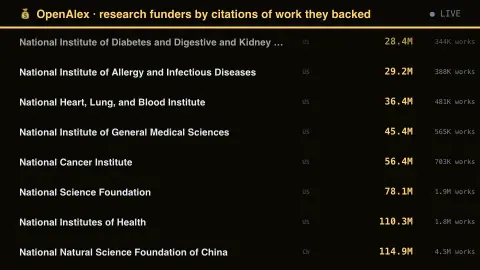
The Who Pays For Science screensaver shows research funders ranked by the citations of work they backed, key-less from OpenAlex. The ranking measures reach rather than merit: a body funding a lot of medicine outranks one funding a lot of mathematics regardless of quality. Grant counts are null across this endpoint, so works and citations are drawn and the grant count is not. It's free, runs in your browser, and ESC exits.
Live preview
Press ESC to leave fullscreen. Settings are saved in your browser only.
How the Who Pays For Science screensaver works
The saver reads the source described above and draws it on a canvas — no account, no tracking.
Research funders ranked by the citations of work they backed, key-less from OpenAlex. The ranking measures reach rather than merit: a body funding a lot of medicine outranks one funding a lot of mathematics regardless of quality. Grant counts are null across this endpoint, so works and citations are drawn and the grant count is not.
It refreshes on a schedule, so what you see stays current.
Colours can be changed in settings; nothing is stored beyond your own browser.
Reading funder data in OpenAlex
OpenAlex is an open index of scholarly works, authors, institutions and funders, produced by the non-profit OurResearch. It began operating in January 2022 as a successor to the Microsoft Academic Graph, which stopped being updated at the end of 2021. Its funders entity covers around 45,000 organisations, such as government agencies, foundations and charities, each linked to the works it funded.
OpenAlex does not observe funding directly. It infers funders from work metadata, such as Crossref records and funders’ own grant records, and matches those mentions to a funder list built on the Crossref Open Funder Registry. Each funder record carries counts including works_count, the number of works naming that funder, and cited_by_count, the total citations across those works.
A citation is a reference from another paper, so a high total suggests wide visibility rather than quality. Citation habits differ between fields, so totals are not comparable across disciplines. Because funding is inferred from metadata, some works are missed and records can be incomplete. Read the ranking as a rough map of where cited research is concentrated, not a measure of how effective any funder is.
A worked example
Research funders ranked by the citations of work they backed, key-less from OpenAlex. The ranking measures reach rather than merit: a body funding a lot of medicine outranks one funding a lot of mathematics regardless of quality. Grant counts are null across this endpoint, so works and citations are drawn and the grant count is not.
Settings & tips
- Accent and Background recolour the display.
- Every value on screen comes from the live source — nothing is simulated.
- Press ESC to leave fullscreen.
Frequently asked questions
- Is this real data?
- Yes — it comes from the source named on this page and is refreshed on a schedule.
- Is a key needed?
- No. This source is fully key-less.
- Is it free?
- Yes, and it runs entirely in your browser.
- Does a higher citation total mean better science?
- No. Citations show attention, and they vary by field and by the age of the work. A big funder will accumulate large totals simply by funding more papers.
- How does OpenAlex know who funded a paper?
- It infers funders from work metadata, such as Crossref records and funders’ own grant records, and matches them to a funder list based on the Crossref Open Funder Registry. Because it is inferred, coverage is incomplete.
- What do works and citations count for a funder?
- Works is the number of works that name the funder, and citations is the total citations received across all of those works.