Reconstructed Neurons Screensaver
The Reconstructed Neurons screensaver shows individual reconstructed neurons from NeuroMorpho.Org, key-less. It's free, runs in your browser, and ESC exits.
Live preview
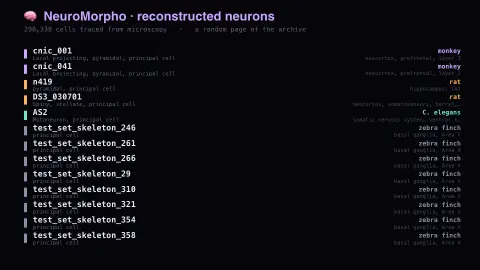
Press ESC to leave fullscreen. Settings are saved in your browser only.
How the Reconstructed Neurons screensaver works
The saver reads the source described above and draws it on a canvas — no account, no tracking.
Individual reconstructed neurons from NeuroMorpho.Org, key-less. Every entry is one real cell somebody traced from microscopy and deposited: a specific pyramidal cell from a specific rat's hippocampus, in a specific lab's archive. Nearly 300,000 of them.
It refreshes on a schedule, so what you see stays current.
Colours and any options can be changed in settings; nothing is stored beyond your own browser.
What a neuron reconstruction is
NeuroMorpho.Org is a centrally curated inventory of digitally reconstructed neurons and glia, with contributions from hundreds of laboratories; its pages credit George Mason University. A reconstruction is a tracing of a stained cell through microscope images, stored as a three-dimensional skeleton of connected points, each with a position and a radius.
Those skeletons are stored in the plain-text SWC format. Each line is one point with seven fields: an index, a type code (such as soma, axon or dendrite), x, y and z positions in micrometres, a radius, and the index of its parent point. Because they are just numbers, the cells can be measured, compared and fed into simulations. Each record also carries metadata about the cell and the lab that contributed it, along with computed morphometric features.
Read the entries as a sample of what labs chose to trace and deposit, not of nervous systems at large. The archive spans dozens of species, but a few dominate by count: mouse and rat lead, followed by fruit fly and human. A reconstruction records shape well, though preparation of the tissue can alter its size.
A worked example
Individual reconstructed neurons from NeuroMorpho.Org, key-less. Every entry is one real cell somebody traced from microscopy and deposited: a specific pyramidal cell from a specific rat's hippocampus, in a specific lab's archive. Nearly 300,000 of them.
Settings & tips
- Accent and Background recolour the display.
- Every value on screen comes from the live source — nothing is simulated.
- Press ESC to leave fullscreen.
Frequently asked questions
- Is this real data?
- Yes — it comes from the source named on this page and is refreshed on a schedule.
- Is a key needed?
- No. This source is fully key-less.
- Is it free?
- Yes — free, no download, in your browser.
- What is the SWC format?
- It is a plain-text format in which every line describes one point of a traced neuron: an index, a structure type, x, y and z coordinates in micrometres, a radius and the index of its parent point.
- Why are some species so common?
- An archive reflects what labs choose to study and share. Mouse and rat tissue make up the largest counts, while other species appear only where a lab traced and deposited them.