Quasicrystal Waves Screensaver
Quasicrystal Waves is a free, in-browser screensaver that sums several plane waves crossing at equal angles. With five, seven or eleven waves the sum has a rotational symmetry no repeating lattice can have — the signature of a quasicrystal — so the pattern is ordered everywhere yet repeats nowhere. Advancing the phase makes it breathe. Nothing to download, and ESC exits at any time.
Live preview
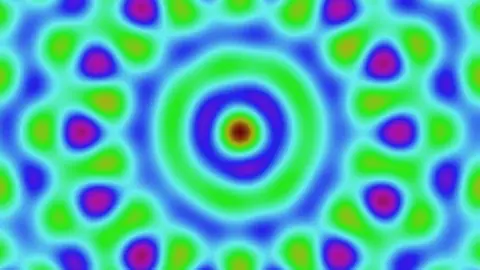
Press ESC to leave fullscreen. Settings are saved in your browser only.
How the Quasicrystal Waves screensaver works
A plane wave is a cosine that varies along one direction. Take N of them with their directions spread evenly over a half turn, add them up at every pixel, and map the result to a palette. That is the entire recipe; everything else is which N and what colours.
For N = 2 or 3 the sum is a periodic pattern — a checkerboard, a triangular lattice. For N = 5, 7, 11 or any other odd number past three the sum has N-fold rotational symmetry, and the crystallographic restriction theorem proves no periodic tiling can have that. The pattern is quasiperiodic: locally ordered, never exactly repeating.
The same phase is added to every wave each frame, so the whole pattern pulses without drifting; the spatial frequency also breathes slowly, which reads as a gentle zoom. Odd N gives the classic quasicrystal look; even N adds a mirror axis.
The frame is computed into a reduced-resolution buffer and scaled up, and the per-pixel work is only N cosines, so even at fullscreen it is cheap.
Quasicrystals and the forbidden five-fold symmetry
For most of the history of crystallography it was held that a crystal could not have five-fold rotational symmetry, because pentagons cannot tile a flat plane without gaps. The crystallographic restriction theorem allows only two-, three-, four- and six-fold symmetry in a repeating lattice. In 1982 Dan Shechtman observed ten-fold electron diffraction patterns in an aluminium–manganese alloy, an apparent impossibility that was met with scepticism. He received the Nobel Prize in Chemistry in 2011, and in 1992 the International Union of Crystallography revised its definition of a crystal to allow aperiodic order.
The resolution is that such materials are ordered but not periodic. A related two-dimensional example is the Penrose tiling: Roger Penrose’s two-tile set from 1974 produces only non-periodic tilings of the plane, with five-fold symmetry. Mathematicians describe these as quasiperiodic, and a standard way to build them is to project a slice of a higher-dimensional lattice, or to add up several waves at incommensurate angles.
The waves here follow the second route. Each is an ordinary periodic cosine, but their directions are spaced so no shift of the whole picture can line everything up again. The result looks tidy yet never repeats, which is a fair intuitive picture of a quasicrystal.
A worked example
At the defaults — 7 waves, Spectrum palette, Speed 4 — the screen fills with seven-fold rosettes that flow into one another, brightening and dimming in waves as the phase advances. Set the wave count to 5 and the rosettes become the pentagonal motifs of a Penrose tiling; set it to 11 and they blur toward rings.
Settings & tips
- 5, 7 and 11 waves are the classic quasicrystal counts; 4 or 6 give ordinary crystalline lattices for comparison.
- Mono with a pale accent on a dark background looks like an electron-diffraction image.
- Speed 1 with Pixel size 1 makes a slow, high-resolution wallpaper.
Frequently asked questions
- What is a quasicrystal?
- A solid whose atoms are ordered but never repeat periodically, with symmetries such as five-fold that a periodic crystal cannot have. Dan Shechtman found the first one in 1982 and won the 2011 Nobel Prize in Chemistry for it; this pattern is the two-dimensional wave picture of the same idea.
- Why does the pattern never repeat?
- Because the ratios between the wave directions are irrational, so no translation lines every wave up with itself again. The result can look almost the same in many places without ever being identical.
- Will this slow my computer down?
- It is tuned to run smoothly on an ordinary laptop. If it feels heavy, raise the Pixel size or lower the speed in the settings; every control takes effect immediately.
- Is the Quasicrystal Waves screensaver free?
- Yes. It runs free in your browser with nothing to download or install, and it keeps working offline once the page has loaded.
- How do I exit the Quasicrystal Waves screensaver?
- Press the ESC key at any time to leave fullscreen and return to the page.
- Do quasicrystals occur in nature?
- Yes. The mineral icosahedrite, identified in 2009 from samples of the Khatyrka meteorite, was the first natural quasicrystal found. A second, with ten-fold symmetry, was later found in Khatyrka fragments.
- Why was five-fold symmetry thought impossible in crystals?
- The crystallographic restriction theorem shows that a repeating lattice can only have two-, three-, four- or six-fold rotational symmetry. Shechtman’s ten-fold diffraction pattern appeared to break that rule, which is why it was so surprising.
- How is this different from a Penrose tiling?
- A Penrose tiling is built from two tile shapes that fit together without repeating, while this picture is an interference pattern of waves. Both show non-repeating order.