Proteins That Touch Screensaver
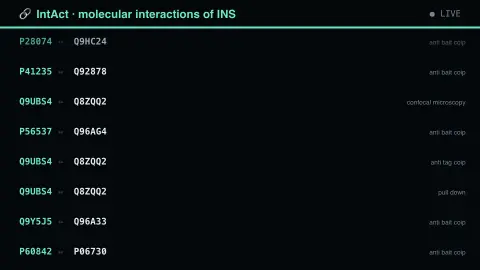
The Proteins That Touch screensaver shows experimentally observed molecular interactions from EMBL-EBI's IntAct, key-less. Self-interactions — the same accession on both sides — are real and common, because a great many proteins only function as dimers of themselves. A protein is picked at random each cycle so the saver walks the interactome rather than sitting on one gene. It's free, runs in your browser, and ESC exits.
Live preview
Press ESC to leave fullscreen. Settings are saved in your browser only.
How the Proteins That Touch screensaver works
The saver reads the source described above and draws it on a canvas — no account, no tracking.
Experimentally observed molecular interactions from EMBL-EBI's IntAct, key-less. Self-interactions — the same accession on both sides — are real and common, because a great many proteins only function as dimers of themselves. A protein is picked at random each cycle so the saver walks the interactome rather than sitting on one gene.
It refreshes on a schedule, so what you see stays current.
Colours can be changed in settings; nothing is stored beyond your own browser.
How IntAct records molecular interactions
IntAct is an open molecular interaction resource run at EMBL-EBI, the European Bioinformatics Institute. Its records are curated from the scientific literature and from direct data depositions, and it takes part in the International Molecular Exchange (IMEx) consortium, whose partners curate to shared standards. Each record describes how experimenters detected that two molecules, most often proteins, bind or associate, and the molecules are named by accession, such as a UniProt identifier, a stable code for a protein.
An interaction is evidence-based but method-dependent. A pair might be found by a pull-down assay, a yeast two-hybrid screen or a structural study, and each method has typical false positives. IntAct records the detection method and the publication, and provides a normalised MI score from 0 to 1 that weighs how often an interaction has been reported along with the confidence of the techniques used. Being listed means someone reported an observation, not that the interaction happens in every cell.
The data includes interactions where an accession appears on both sides. Many proteins assemble into pairs or larger complexes of identical parts, so this is real biology and not a data error. A list of pairs does not show where or when an interaction occurs, and coverage is uneven: a high score can partly reflect research bias toward some proteins, and well-studied proteins accumulate far more records than obscure ones.
A worked example
Experimentally observed molecular interactions from EMBL-EBI's IntAct, key-less. Self-interactions — the same accession on both sides — are real and common, because a great many proteins only function as dimers of themselves. A protein is picked at random each cycle so the saver walks the interactome rather than sitting on one gene.
Settings & tips
- Accent and Background recolour the display.
- Every value on screen comes from the live source — nothing is simulated.
- Press ESC to leave fullscreen.
Frequently asked questions
- Is this real data?
- Yes — it comes from the source named on this page and is refreshed on a schedule.
- Is a key needed?
- No. This source is fully key-less.
- Is it free?
- Yes, and it runs entirely in your browser.
- What is an accession?
- A stable identifier for a molecule in a reference database, such as a UniProt code for a protein, used so that names and synonyms do not cause confusion.
- Does an interaction mean two proteins always bind?
- No. It means an experiment detected an association under particular conditions, and in a living cell it may depend on location, timing or other factors.
- What is the MI score?
- A normalised score from 0 to 1 that weights how often an interaction has been reported and how confident the detection techniques are. It can also reflect research bias toward popular proteins.