A Bestiary With Statistics Screensaver
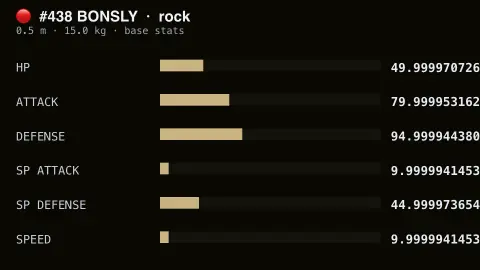
The A Bestiary With Statistics screensaver shows pokédex entries, key-less and live from PokeAPI. This is a game's design document exposed as an API, and the base stats sum to a deliberate budget, so the bars are a designer's balancing decisions made visible. Bars scale against 255 — the hard ceiling a base stat can take — rather than against the creature's own best, which would make every one look equally strong. It's free, runs in your browser, and ESC exits.
Live preview
Press ESC to leave fullscreen. Settings are saved in your browser only.
How the A Bestiary With Statistics screensaver works
The saver reads the source described above and draws it on a canvas — no account, no tracking.
Pokédex entries, key-less and live from PokeAPI. This is a game's design document exposed as an API, and the base stats sum to a deliberate budget, so the bars are a designer's balancing decisions made visible. Bars scale against 255 — the hard ceiling a base stat can take — rather than against the creature's own best, which would make every one look equally strong.
It refreshes on a schedule, so what you see stays current.
Colours can be changed in settings; nothing is stored beyond your own browser.
PokeAPI and the six base stats
PokeAPI is a free, read-only web API for Pokémon data, so developers can build tools without scraping wiki pages. It needs no authentication and offers only HTTP GET. Its documentation covers resource groups such as Pokémon, species, moves, abilities, types, natures, games and evolution. The code is open source under the BSD-3-Clause licence and lives in the PokeAPI organisation on GitHub, supported by community contributors.
The main-series games are developed mainly by Game Freak and published by Nintendo and The Pokémon Company. Every species has six base stats: HP, Attack, Defense, Special Attack, Special Defense and Speed. Base stats are fixed per species and feed into the calculation of a creature's actual stats, which also depends on other factors such as level and nature. In PokeAPI's documentation, a nature raises one stat by 10% and lowers another by 10%. A listed base stat is therefore a starting point, not what a creature has in battle.
The sum of the six is often used as a rough index of overall power. Forms and regional variants of a species can have different stats from the original, so the same name does not always mean the same numbers.
A worked example
Pokédex entries, key-less and live from PokeAPI. This is a game's design document exposed as an API, and the base stats sum to a deliberate budget, so the bars are a designer's balancing decisions made visible. Bars scale against 255 — the hard ceiling a base stat can take — rather than against the creature's own best, which would make every one look equally strong.
Settings & tips
- Accent and Background recolour the display.
- Every value on screen comes from the live source — nothing is simulated.
- Press ESC to leave fullscreen.
Frequently asked questions
- Is this real data?
- Yes — it comes from the source named on this page and is refreshed on a schedule.
- Is a key needed?
- No. This source is fully key-less.
- Is it free?
- Yes, and it runs entirely in your browser.
- What are base stats?
- They are the fixed numbers for HP, Attack, Defense, Special Attack, Special Defense and Speed that define a species. In-game stats are calculated from them plus level, nature and other factors.
- Is PokeAPI run by the game's publishers?
- Nothing in its documentation or repository describes it as run by them. It is an open-source project maintained by contributors, compiling information about the games.
- Do base stats equal a creature's real battle stats?
- No. Actual stats are calculated from base stats together with level, nature and other factors, so two creatures of the same species can differ.