Phase Music Screensaver
A free screensaver that plays two copies of one short looping figure, one fractionally faster than the other, so they drift out of step and slowly realign, in the style of Steve Reich's phasing pieces. Sound starts only after your first click or key press, because browsers block audio until then; until that moment the screensaver runs silently. Press ESC to exit.
Live preview
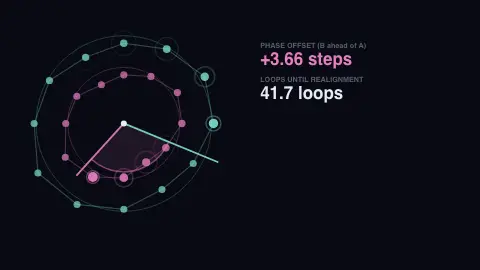
Press ESC to leave fullscreen. Settings are saved in your browser only.
How the Phase Music screensaver works
Two voices play the same figure, a short pentatonic pattern of 8, 10 or 12 steps that was composed for this saver. Voice A plays at a fixed rate. Voice B plays (L+1)/L times as fast, where L is set by the Drift speed option; for example L = 60 gives a ratio of 61/60.
Because B is faster, it gains 1/L of a step on A with every step A plays. After exactly L loops of A, B has played L+1 loops and the two line up again. The offset on screen is computed from the two playing clocks, in steps, and the loops until realignment is L times the fraction of the figure still to go; the time shown multiplies that by the loop length at your tempo.
On the dial, A is the outer ring and B the inner ring; each step is a dot nudged outward for higher notes, so the figure's contour is visible. The coloured wedge between the two hands is the offset. At whole-step offsets the two voices play the same figure shifted by that many steps; in between, the notes smear against each other.
The notes are synthesised in the browser with the Web Audio API (marimba, glass bell, soft electric piano or pluck), A panned slightly left and B slightly right. A compressor limits the level and the master volume is low. Sound starts only after your first click or key press, because browsers block audio until then; until that moment the screensaver runs silently.
Phasing in minimalist music
Steve Reich's Piano Phase, composed in 1967 for two pianos or piano and tape, begins with two players playing the same twelve-note figure together. One then gradually plays slightly faster, so the parts drift apart until they realign (Wikipedia, Piano Phase). The later sections reduce the figure to eight and then four notes.
This saver uses the same basic idea with a fixed tempo difference rather than an accelerating player, and with figures written fresh for it. The ratio is exact, so the drift is smooth and the time to realign can be stated exactly.
No claim is made that the output resembles a performance of any Reich work; it is a small demonstration of how two identical loops at slightly different rates create changing patterns.
A worked example
With Tidewater (12 steps) and the default drift, L is 60, so B runs 61/60 as fast as A. B gains 1/60 of a step per step, so after 60 steps (5 loops) the offset is 1 step, and after 60 loops it is a full 12 steps and the voices realign. At 5.5 steps per second one loop takes about 2.18 s, so a full cycle takes about 2 min 11 s.
Settings & tips
- Figure chooses one of three original figures; all are pentatonic.
- Drift speed sets L, the number of loops until realignment, from 240 (slowest) to 24 (fastest).
- Tempo sets how many steps play per second.
- Voice changes the timbre of both voices.
- Click once or press any key for sound; click again or press M to mute. Press ESC to leave fullscreen.
Frequently asked questions
- Are these Steve Reich's notes?
- No. The figures are original patterns written for this saver. Only the phasing process, one copy gradually pulling ahead of another, is borrowed.
- Is the offset real or animated?
- It is calculated from the two voices' playing clocks, using the exact ratio (L+1)/L, and it is the same offset the scheduler uses to place notes.
- Why does it start in unison?
- Both voices start together. When sound starts after a click, the process restarts from unison.
- How is the realignment time worked out?
- B gains 1/L of a step per step, so a full figure of N steps takes N times L steps, which is L loops of A. The time shown is the remaining loops times N steps at your tempo.
- Is it a recording?
- No. Everything is synthesised live from the rules above, with no samples and no audio files.
- Why is there no sound at first?
- Browsers block audio until you click or press a key. The dials run silently until then.
- Does it model a performer speeding up, as in Piano Phase?
- No. In Piano Phase one player gradually plays slightly faster. This saver does not model a performer; it drifts continuously at a fixed, exact ratio.