Paris Vélib' Screensaver
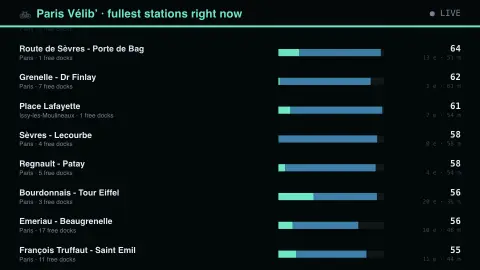
The Paris Vélib' screensaver shows live dock availability across the Paris bike share, station by station, with the split between electric and mechanical bikes drawn as a two-tone bar. That split is the interesting column. It runs in the browser with nothing to install; press ESC to exit.
Live preview
Press ESC to leave fullscreen. Settings are saved in your browser only.
How the Paris Vélib' screensaver works
The saver reads The Paris open data platform, which republishes Vélib' availability in real time.
No account and no key: the request goes straight from your browser, or from this site's own refreshed copy of the feed where the source does not allow browser access.
Values are drawn on a canvas that resizes with the window, so it works on a laptop or a wall display.
If the source is unreachable the saver says so on screen rather than showing stale numbers as though they were current.
Paris's bike-share network and its data
Vélib' began operating in Paris on 15 July 2007 as a large public bike-share system. JCDecaux ran it under a concession until the end of 2017, and from 2018 it has been operated by Smovengo under the name Vélib' Métropole, under a contract awarded by the Syndicat mixte Autolib' Vélib' Métropole. The 2018 contract called for a share of the bikes to be electric-assist, and the network now covers Paris and dozens of surrounding municipalities, with roughly 1,400 stations.
The open data feed on the Paris platform shows real-time availability of free docks, mechanical bikes and electric bikes at each station, in the GBFS format, and the datasets are refreshed every minute. Because the numbers move that quickly, the picture shifts fast during commute hours, and the split between bike types is visible at each station separately.
Station counts are a snapshot, so a bike counted as available may still have a fault that has not yet been reported. The feed counts electric bikes but says nothing about how charged their batteries are. Readings are only as current as the last refresh, which is why the saver shows an error rather than old numbers when the source cannot be reached.
A worked example
Each station shows its name, arrondissement, free docks and total bikes, with a bar split green for electric and blue for mechanical. Electric bikes are taken first and returned wherever the rider ran out of charge, so a station full of mechanical bikes and empty of electric ones is usually at the top of a hill. Both bikes and free docks are shown, because a full station is a different problem from an empty one.
Settings & tips
- Accent and Background recolour the display without changing the data.
- Add it to a Multi-view grid to watch it alongside other live savers.
- Press ESC at any time to leave fullscreen.
Frequently asked questions
- Why show free docks as well as bikes?
- Because arriving at a station with no free dock is as much of a problem as arriving at one with no bikes. Riders need both numbers, and a station can easily be full of bikes and impossible to return to.
- Why does the electric-mechanical split matter?
- Because it tells you about the terrain and the time of day. Electric bikes go first, so a station left with only mechanicals is either uphill or has just been drained by a rush.
- Is this real data?
- Yes. It comes from The Paris open data platform, which republishes Vélib' availability in real time. Nothing is invented or simulated, and if the source cannot be reached the saver reports that instead of drawing something plausible.
- Does it cost anything or need an account?
- No. Every screensaver here is free, runs in the browser and needs no sign-up. This one uses a public API that requires no key.
- How often does the data update?
- The Paris open data platform states that the Vélib' availability datasets are refreshed every minute, so a reading is at most a minute or so old when the source is working normally.
- Are electric bikes counted separately?
- Yes, the feed reports mechanical and electric bikes as separate counts alongside the number of free docks, so availability of one type can differ from the other at the same station.
- Who operates Vélib' today?
- Smovengo has operated the system since 2018, replacing JCDecaux, which ran it from 2007 to the end of 2017. The service is organised by the Syndicat mixte Autolib' Vélib' Métropole.