Portugal Publishing Itself Screensaver
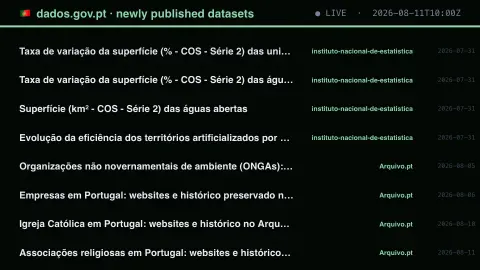
The Portugal Publishing Itself screensaver shows datasets newly published to Portugal's open data portal, key-less. Arquivo.pt appears often and is worth knowing about: it is the national web archive, and it publishes datasets about the archived web — which company sites existed and when they vanished. An archive treating its own crawl history as open data is unusual. It's free, runs in your browser, and ESC exits.
Live preview
Press ESC to leave fullscreen. Settings are saved in your browser only.
How the Portugal Publishing Itself screensaver works
The saver reads the source described above and draws it on a canvas — no account, no tracking.
Datasets newly published to Portugal's open data portal, key-less. Arquivo.pt appears often and is worth knowing about: it is the national web archive, and it publishes datasets about the archived web — which company sites existed and when they vanished. An archive treating its own crawl history as open data is unusual.
It refreshes on a schedule, so what you see stays current.
Colours can be changed in settings; nothing is stored beyond your own browser.
Inside Portugal's open data portal
Dados.gov.pt is the open data portal of the Portuguese public administration. It is developed and managed by AMA, the Agência para a Modernização Administrativa, and has served as the national open data portal since 2011. A 2018 relaunch moved it onto udata, an open-source platform created by Etalab, the French government’s digital service.
It works as a central catalogue. Bodies across the public administration publish datasets there, any public body may use it to do so, and it also indexes other open data portals, such as municipal ones like Lisbon’s city council. Each entry has a title, a description and the organisation that published it, which is what you see alongside the title in the display.
A new entry shows that a dataset was catalogued, not that it contains fresh data: a publisher may register a historical series, a revised file or a new version of something older. Quality varies between publishers, and a description may be brief. The display shows what has been listed on the portal and does not assess the contents.
A worked example
Datasets newly published to Portugal's open data portal, key-less. Arquivo.pt appears often and is worth knowing about: it is the national web archive, and it publishes datasets about the archived web — which company sites existed and when they vanished. An archive treating its own crawl history as open data is unusual.
Settings & tips
- Accent and Background recolour the display.
- Every value on screen comes from the live source — nothing is simulated.
- Press ESC to leave fullscreen.
Frequently asked questions
- Is this real data?
- Yes — it comes from the source named on this page and is refreshed on a schedule.
- Is a key needed?
- No. This source is fully key-less.
- Is it free?
- Yes, and it runs entirely in your browser.
- Who runs the portal?
- It is developed and managed by AMA, the Agência para a Modernização Administrativa, and is built on udata, open-source software created by Etalab, the French government’s digital service.
- Who can publish on the portal?
- It is used by public administration bodies to publish data, and any public body may use it for that. It also indexes other open data portals, such as municipal ones.
- Does a new listing mean new data?
- Not always. A listing can be an older dataset that was only recently catalogued, or a revised version of an existing one.