Switzerland Publishing Itself Screensaver
The Switzerland Publishing Itself screensaver shows datasets newly published to opendata.swiss, key-less. Titles arrive in whichever of the four national languages the publishing canton works in, and they are left that way: a dataset named in Romansh is shown named in Romansh. It's free, runs in your browser, and ESC exits.
Live preview
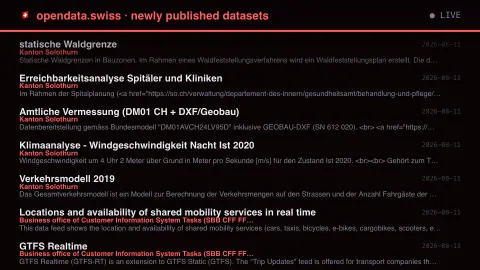
Press ESC to leave fullscreen. Settings are saved in your browser only.
How the Switzerland Publishing Itself screensaver works
The saver reads the source described above and draws it on a canvas — no account, no tracking.
Datasets newly published to opendata.swiss, key-less. Titles arrive in whichever of the four national languages the publishing canton works in, and they are left that way: a dataset named in Romansh is shown named in Romansh.
It refreshes on a schedule, so what you see stays current.
Colours can be changed in settings; nothing is stored beyond your own browser.
About opendata.swiss and its four languages
opendata.swiss is the national portal for Swiss open government data, run by the Federal Statistical Office as a joint project of the Confederation, cantons, communes and other organisations with a mandate from the state. It is a catalogue rather than a data store: each entry carries a title, description, publisher and links to files or services that sit on the publishers’ own servers. A dataset might be a statistical table, a map layer or a timetable extract.
Switzerland has four national languages, German, French, Italian and Romansh, and the language of a record is set per dataset rather than for the whole portal. What you see scrolling past is whichever title the record provides, so a dataset from a German-speaking canton will typically read in German and one from a French-speaking canton in French. Some records are given in several languages, others in just one.
Two cautions apply. An entry is only a pointer to data held elsewhere: some datasets are updated regularly while others are one-off releases that may not have changed in years. Appearing on the portal says nothing about how current or complete a dataset is, and a newly catalogued entry is not necessarily newly produced data.
A worked example
Datasets newly published to opendata.swiss, key-less. Titles arrive in whichever of the four national languages the publishing canton works in, and they are left that way: a dataset named in Romansh is shown named in Romansh.
Settings & tips
- Accent and Background recolour the display.
- Every value on screen comes from the live source — nothing is simulated.
- Press ESC to leave fullscreen.
Frequently asked questions
- Is this real data?
- Yes — it comes from the source named on this page and is refreshed on a schedule.
- Is a key needed?
- No. This source is fully key-less.
- Is it free?
- Yes, and it runs entirely in your browser.
- Why are the titles in different languages?
- The language is set per dataset, and the portal keeps titles as the publisher supplied them. Some entries are given in several languages and others in only one.
- Does a new entry mean new data?
- Not necessarily. It means a catalogue record appeared; the dataset behind it may be an older release newly registered, or a long-running series.
- Who publishes to the portal?
- The portal is a joint project of the Confederation, cantons, communes and other organisations with a mandate from the state, and the Federal Statistical Office runs it.