France Publishing Itself Screensaver
The France Publishing Itself screensaver shows datasets newly published to data.gouv.fr, key-less. This portal is not CKAN despite sitting beside a dozen that are, and the difference is silent rather than loud: rows arrive under a bare data array instead of result.results, the description field is description rather than notes, and the date is created_at. Reading it with CKAN field names returns an empty screen and no error at all. It's free, runs in your browser, and ESC exits.
Live preview
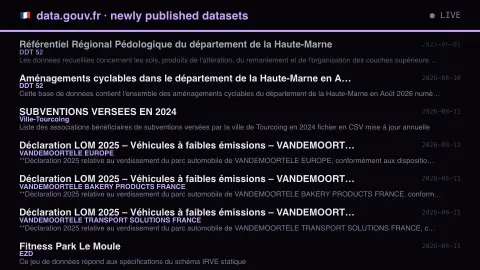
Press ESC to leave fullscreen. Settings are saved in your browser only.
How the France Publishing Itself screensaver works
The saver reads the source described above and draws it on a canvas — no account, no tracking.
Datasets newly published to data.gouv.fr, key-less. This portal is not CKAN despite sitting beside a dozen that are, and the difference is silent rather than loud: rows arrive under a bare data array instead of result.results, the description field is description rather than notes, and the date is created_at. Reading it with CKAN field names returns an empty screen and no error at all.
It refreshes on a schedule, so what you see stays current.
Colours can be changed in settings; nothing is stored beyond your own browser.
Who publishes on data.gouv.fr
data.gouv.fr is the French national open data platform. It is owned and developed by DINUM, the interministerial digital directorate, and was created by Etalab under the authority of the Prime Minister; the first version launched in December 2011. Its engine is an open-source platform called udata, developed since 2014 and released under the AGPL, which other countries have also reused for their own open data portals, among them Luxembourg and Portugal.
The platform is collaborative: since its 2013 version, citizens and associations as well as public bodies can publish datasets, and users can also share reuses, such as applications, web services, statistical analyses and press articles, alongside the data. That openness changes what a list of new datasets means. An entry may be an official table from a national agency, a city's open budget, or a file compiled by a volunteer, so the publisher's name on each entry matters when judging how authoritative it is.
Most titles and descriptions are in French. Etalab created the Licence Ouverte, a free licence designed for use notably on data.gouv.fr, but each dataset states its own licence. A dataset's recent creation date shows when it was listed, not necessarily when the underlying data was collected.
A worked example
Datasets newly published to data.gouv.fr, key-less. This portal is not CKAN despite sitting beside a dozen that are, and the difference is silent rather than loud: rows arrive under a bare data array instead of result.results, the description field is description rather than notes, and the date is created_at. Reading it with CKAN field names returns an empty screen and no error at all.
Settings & tips
- Accent and Background recolour the display.
- Every value on screen comes from the live source — nothing is simulated.
- Press ESC to leave fullscreen.
Frequently asked questions
- Is this real data?
- Yes — it comes from the source named on this page and is refreshed on a schedule.
- Is a key needed?
- No. This source is fully key-less.
- Is it free?
- Yes, and it runs entirely in your browser.
- Can anyone publish on data.gouv.fr?
- Largely yes. Since the 2013 version of the platform, citizens and associations as well as public bodies can publish datasets, which is why it contains community contributions as well as official releases.
- What is udata?
- It is the open-source software behind the portal, licensed under the AGPL. Other bodies can reuse it; Luxembourg and Portugal have done so for their open data platforms.
- What licence do the datasets use?
- Each dataset page states its licence. Many public-sector datasets use the Licence Ouverte created by Etalab, but others carry different terms.