Who Can Actually Read It Screensaver
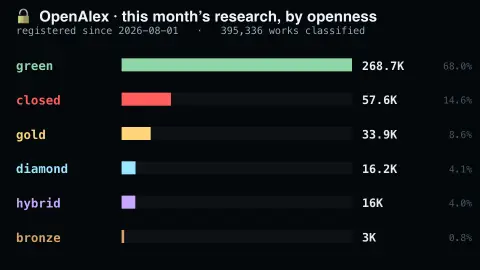
The Who Can Actually Read It screensaver shows the open-access status of this month's research from OpenAlex, key-less. Green usually leads, which is not the victory it appears to be: it means an open copy sits in a repository in spite of the publisher rather than because of one. It's free, runs in your browser, and ESC exits.
Live preview
Press ESC to leave fullscreen. Settings are saved in your browser only.
How the Who Can Actually Read It screensaver works
The saver reads the source described above and draws it on a canvas — no account, no tracking.
The open-access status of this month's research from OpenAlex, key-less. Green usually leads, which is not the victory it appears to be: it means an open copy sits in a repository in spite of the publisher rather than because of one.
It refreshes on a schedule, so what you see stays current.
Colours and any options can be changed in settings; nothing is stored beyond your own browser.
How OpenAlex labels open access
OpenAlex is an open catalogue of scholarly works, authors, journals and institutions, built by the nonprofit OurResearch as a successor to Microsoft Academic Graph, which stopped being updated at the end of 2021. For every work it tries to work out whether a free-to-read copy exists, and if so where, and assigns an open-access status.
The statuses are diamond, gold, green, hybrid, bronze and closed. Gold and diamond refer to works in fully open-access journals. Hybrid means open inside an otherwise subscription journal. Bronze means free to read on the publisher’s site without a clear open licence. Green means a copy sits in a repository, such as a preprint server or a university archive. Closed means no free copy was found. OpenAlex’s own documentation notes that the bronze-versus-gold split depends on the journal’s openness.
Treat the proportions as a best guess. Statuses are inferred from several sources and can change as new repository copies are found, so a count for a recent month may later be revised. The count is of works indexed, not of how often they are read.
A worked example
The open-access status of this month's research from OpenAlex, key-less. Green usually leads, which is not the victory it appears to be: it means an open copy sits in a repository in spite of the publisher rather than because of one.
Settings & tips
- Accent and Background recolour the display.
- Every value on screen comes from the live source — nothing is simulated.
- Press ESC to leave fullscreen.
Frequently asked questions
- Is this real data?
- Yes — it comes from the source named on this page and is refreshed on a schedule.
- Is a key needed?
- No. This source is fully key-less.
- Is it free?
- Yes, and it runs entirely in your browser.
- What is the difference between gold and bronze?
- Gold papers appear in journals that are open access. Bronze papers are free to read on the publisher's site but without a clear open licence, and OpenAlex notes the distinction depends on the journal's openness.
- Why can a month's figures change later?
- Statuses are inferred from several sources, so a work first counted as closed can be re-labelled once a free copy, such as a repository copy, is found.